
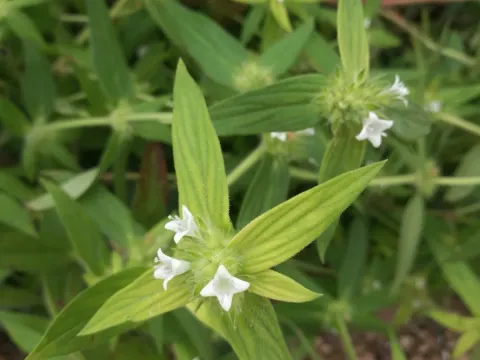
Spermacoce stachydea
Spermacoce stachydea
Spermacoce stachydea is a herbaceous plant belonging to the large Rubiaceae family. In its natural tropical habitats of Africa and South America, the plant typically propagates with the onset of the rainy season, when soil moisture levels become optimal for seed germination and initial establishment.
What the section contains
Spermacoce stachydea
For agricultural cultivation, seeds are sown in well-prepared plots tailored to the needs of small-seeded species. Sowing depth must be kept shallow, as the small seeds require adequate light exposure and consistent warmth to initiate successful germination within the first weeks of the growing cycle.
The preparation of a friable, nutrient-rich substrate is vital for successful sowing. Due to the species' high natural self-seeding capability, it is often managed as a self-renewing forage crop, allowing for easy establishment of dense stands in pasture environments.
Planting density is adjusted according to the intended use: higher densities are utilized for biomass production, while wider spacing is preferred for seed collection. Proper spacing promotes robust flower spike development and increases the overall tillering capacity of the plant.
The period from sowing to the flowering stage generally ranges from three to four months, making it a relatively fast-maturing species. Agronomists recommend sowing during periods of stable temperature to ensure uniform germination and synchronous development of shoots.
The crop prefers well-lit environments and moderate moisture levels. Spermacoce stachydea adapts well to soils with acidic to neutral pH, demonstrating significant versatility across various tropical soil types, including sandy loams and clay-rich substrates typical of its native range.
As a heat-loving plant, it is highly sensitive to frost. The optimal temperature range for active growth is between +22 and +30 degrees Celsius, though the species shows resilience to brief dry spells due to the adaptive structure of its root system.
Standard cultivation practices include regular inter-row weeding and soil loosening to prevent surface crusting, which can impede young seedling development. Applying nitrogen-phosphorus fertilizers during early growth phases significantly enhances overall vegetative biomass accumulation.
Adequate soil drainage is essential, as waterlogging often leads to fungal root rot. While hardy in many respects, the plant is sensitive to high salinity levels in the soil solution, which should be carefully considered when selecting fertilizers or managing site irrigation.
Often occurring as a ruderal species, the plant displays high ecological plasticity. However, during the establishment phase, weed control is necessary to prevent competition, as early-stage growth can be slow compared to more aggressive local grass species.
The primary agricultural utility of Spermacoce stachydea is as a forage resource for livestock in tropical regions. Biomass yield is highly dependent on rainfall distribution and soil fertility, allowing for consistent harvesting throughout the wet season.
The species is also valued for specific metabolites with potential pharmacological properties. Yields of medicinal raw material are measured by the dry weight of aerial parts, harvested during full bloom when the concentration of bioactive compounds is at its peak.
To maximize biomass yield, multiple cuttings are practiced, which stimulates lateral shoot regrowth. This management strategy enables several harvests within a single growing cycle, substantially increasing the economic efficiency of the utilized land area.
Seed collection for future propagation is carried out when the seed pods turn brown, minimizing losses from natural dehiscence. Given the microscopic size of the seeds, meticulous cleaning procedures are required to remove organic debris and ensure high-quality planting material.
Overall productivity remains stable under standard agronomic management. Yield metrics account for both the total volume of harvested material and the nutritional quality, specifically evaluating protein content and fiber composition for livestock use.
Spermacoce stachydea exhibits natural resistance to many common agricultural pests; however, under monoculture conditions, leaf-eating insects may become an issue. Early-stage threats often include soil-borne pests, such as beetle larvae, which can damage the root system.
Regarding diseases, pathogens causing root and crown rot are the most significant risk during periods of excessive soil moisture. Development of foliar mold often occurs in dense stands with poor airflow, necessitating thinning and improved field sanitation practices.
To mitigate disease pressure, crop rotation is strongly recommended to interrupt the life cycle of soil-borne pathogens that can accumulate in the soil over several seasons. Repeatedly growing the crop on the same plot should be avoided for long-term health.
Viral infections, typically transmitted by insect vectors, can manifest as leaf mottling and stunted development. Infected plants should be promptly removed and destroyed to contain potential outbreaks within the field.
Protection strategies are based on an integrated approach: sourcing high-quality seeds, adhering to recommended sowing schedules, and maintaining good agronomic practices. Chemical intervention should be minimized and used only as a last resort, prioritizing ecological health.