
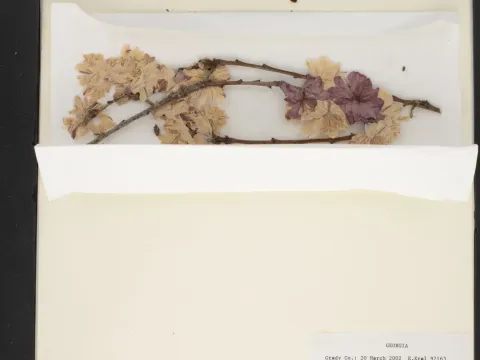
Siebold's cherry
Prunus sieboldii
Siebold's cherry (Latin: Prunus sieboldii) is a species of deciduous trees belonging to the Rosaceae family. In horticulture, it is highly valued as an ornamental flowering plant native to East Asia, including Japan and Korea.
What the section contains
Siebold's cherry
The plant thrives in sunny, sheltered locations protected from strong winds. Optimal growth requires fertile, well-drained loamy soils with a neutral or slightly acidic pH level.
Climatic requirements include moderate humidity and protection from extreme frost. Although the species is quite hardy, young trees require root zone protection in regions with severe winters.
Botanically, the species is characterized by ovate leaves with serrated margins and early, very abundant flowering. The blossoms are clustered in lush inflorescences, ranging in color from white to soft pink.
Its primary use is in landscape design and gardening. Siebold's cherry is frequently used to create alleyways, solitary ornamental plantings, and classic compositions in Japanese-style gardens.
The crop is susceptible to common stone fruit diseases such as brown rot (moniliosis) and leaf spot (coccomycosis). Fungal infections often manifest as leaf spotting or dieback of flowering shoots.
Among the pests, aphids, cherry fruit flies, and leafrollers are the most dangerous. They can significantly reduce the ornamental value of the tree and weaken its resistance to external environmental stressors.
Prevention includes annual sanitary pruning of affected branches and spring spraying with fungicides. It is crucial to avoid waterlogged soil conditions, which trigger the development of root rots.
Regular cleaning of the tree's drip line area from fallen leaves in autumn significantly reduces the number of overwintering pathogen spores. This is a simple yet vital agronomic practice.
In case of severe pest infestation, the use of systemic insecticides is recommended, while strictly following the dosage specified by the manufacturer for stone fruit crops.