
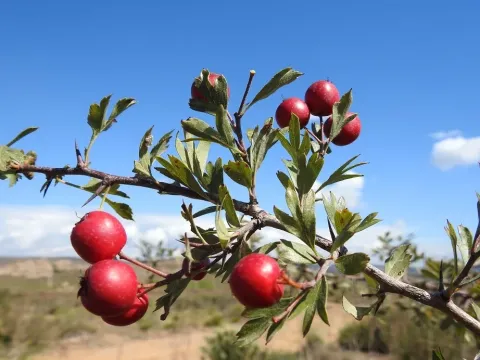
Granada hawthorn
Crataegus granatensis
The Granada hawthorn (Crataegus granatensis) is a distinct species within the Rosaceae family, native to the mountainous regions of Granada, Spain. It is highly adapted to Mediterranean climates characterized by dry summers and mild, cool winters.
What the section contains
Granada hawthorn
For successful cultivation, this plant requires limestone-rich, well-draining soils. It thrives in full sun exposures, which is essential for healthy flower production and fruit maturation. Providing a position with maximum daylight ensures the bush maintains its natural compact form.
The species is notable for its exceptional drought tolerance once established, making it suitable for xeriscaping and rocky slope stabilization. Overwatering should be strictly avoided to prevent root rot, as the species is accustomed to naturally drained mountain substrates.
Basic agricultural care involves light pruning to manage canopy density and encourage airflow, which minimizes the risk of leaf spot diseases. Annual pruning also serves to remove dead wood and maintain the aesthetic value of the shrub in landscape designs.
Young plants benefit from organic mulch around the base to stabilize soil moisture levels during their first two seasons. Once mature, Crataegus granatensis requires very little human intervention, displaying resilience against local climatic extremes.
The harvest of Granada hawthorn fruits occurs at full maturity, typically identified by the deep coloration of the berries. Due to the presence of sharp thorns on the branches, manual harvesting necessitates the use of protective gloves to ensure safety.
These fruits are highly valued in the pharmaceutical industry for their potent bioactive profile, including flavonoids and procyanidins. Extracts derived from them are commonly utilized in supplements supporting cardiovascular health and circulation.
In culinary applications, the berries are processed into jams, jellies, and traditional herbal infusions. Their rich flavor and nutritional profile make them an excellent addition to functional foods and traditional dietary supplements.
Post-harvest handling is critical for maintaining quality. The fruits should be sorted promptly and either processed immediately or dried in a cool, well-ventilated area to prevent degradation of their heat-sensitive phytonutrients.
Beyond fruit production, the wood of Crataegus granatensis is recognized for its density and hardness. Historically and in modern artisanal crafts, it has been prized for small-scale woodturning, tool handles, and decorative interior carvings.