
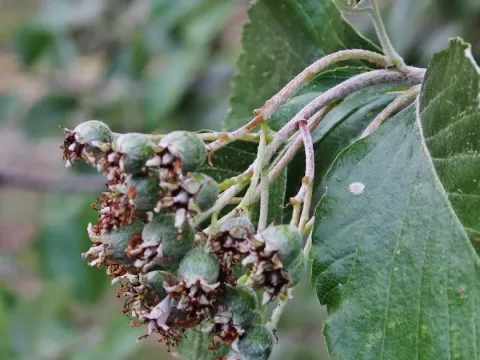
Greek whitebeam
Sorbus graeca
The Greek whitebeam (Sorbus graeca) is a deciduous tree belonging to the Rosaceae family. It is naturally occurring in the Mediterranean region, the Caucasus, and parts of Asia Minor, typically thriving on rocky, limestone-rich slopes.
What the section contains
Greek whitebeam
This species is highly valued in arboriculture for its remarkable tolerance to drought and poor soil quality. It prefers well-drained locations that receive full sunlight, making it an excellent candidate for reforestation and dry-site landscaping.
Climatic requirements are moderate, as the tree adapts well to warm summers and mild winters. While it is hardy in many environments, protecting young saplings from extreme winter winds is recommended to ensure strong initial establishment.
The agricultural management of this species involves minimal interference once established. However, during the planting phase, providing a deep, nutrient-rich planting hole and consistent initial watering will significantly enhance the tree's long-term growth rate.
Botanically, it is characterized by its distinct silvery-white underside of the leaves, which reduces transpiration. The tree develops a dense canopy, producing corymbs of white flowers that eventually turn into small, brownish-red edible fruits.
The economic utility of the Greek whitebeam is primarily focused on fruit production for artisanal food processing. The berries are known for their specific chemical composition, which is useful in the production of jellies, preserves, and traditional medicinal extracts.
Common plant health threats include fungal infections like rust and powdery mildew, especially in sites with poor air circulation. Regular pruning to thin out the canopy is essential to improve airflow and reduce humidity levels around the foliage.
Pests such as aphids and leaf-eating beetles can occasionally impact the plant's health. Integrated Pest Management (IPM) strategies, including the use of biological controls and targeted pruning, are the most effective ways to maintain orchard health.