
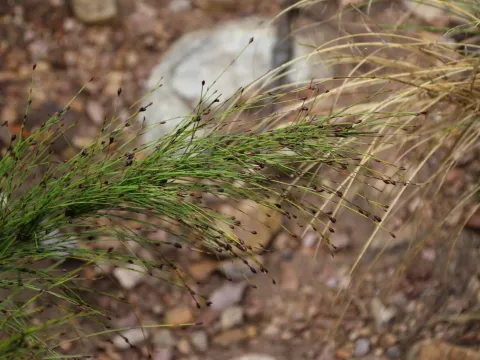
Restio subverticillatus
Restio subverticillatus
Restio subverticillatus belongs to the Restionaceae family, a group of grass-like plants native primarily to the Southern Hemisphere. It is known for its elegant, vertical growth habit and distinctive whorled branch structure.
What the section contains
Restio subverticillatus
Originating from the Cape region of South Africa, this species is well-adapted to Mediterranean climates. It thrives in conditions characterized by mild winters and moderate rainfall, being sensitive to prolonged hard freezes.
The plant requires well-draining, sandy, or loamy soil. It is particularly sensitive to waterlogged conditions, which can be detrimental to its root system; therefore, ensuring proper drainage is a key aspect of site preparation.
For optimal health, it should be grown in full sun. While it can tolerate partial shade in hotter climates to protect it from extreme heat, maximum exposure to light is preferred to maintain its dense and sturdy growth.
Maintaining appropriate soil moisture is essential. While the plant is drought-tolerant once established, it benefits from regular irrigation during the growing season to ensure robust development of its reed-like stems.
Restio subverticillatus is widely valued in horticulture for its architectural appeal. It is commonly used in rock gardens, gravel gardens, and as a modern minimalist feature in contemporary landscape design projects.
The stems of this plant are highly sought after by florists and floral designers. They are harvested for use in dried arrangements and installations where a long-lasting, structural element is required to provide texture and height.
Harvesting is typically carried out by cutting the mature stems near the base. It is essential to use sharp, clean tools to prevent damage to the plant's crown, ensuring that it remains vigorous for the following growing season.
Post-harvest handling involves drying the stems in a cool, shaded, and well-ventilated area. This process helps retain the natural pigment and rigidity of the stems, making them suitable for long-term ornamental use.
Besides its commercial use in the floral industry, this restio is an excellent choice for xeriscaping. It provides a striking, evergreen appearance that complements both native and exotic plant collections in diverse garden settings.