
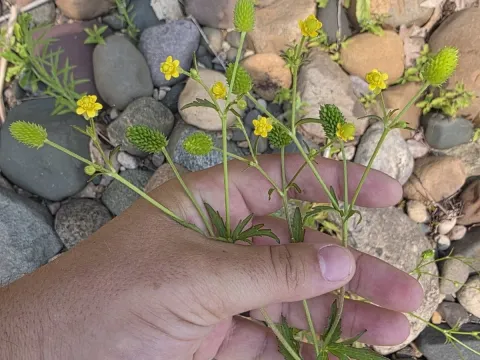
Pennsylvania buttercup
Ranunculus pensylvanicus
The Pennsylvania buttercup (Ranunculus pensylvanicus) is an annual herb belonging to the Ranunculaceae family. It is a highly specialized plant adapted to living in wetland ecosystems across North America.
What the section contains
Pennsylvania buttercup
The species naturally thrives in riverbanks, marshy meadows, and low-lying areas where soil moisture remains consistently high. Its distribution is closely linked to riparian zones that provide essential nutrient-rich sediments.
Botanically, it is distinguished by its erect, hirsute stem and compound leaves. The small yellow flowers are typical of the buttercup genus, blooming during the summer months to ensure pollination within its native habitat.
Environmental requirements include a need for high soil moisture and partial to full sunlight. The plant acts as an ecological indicator for saturated soil conditions, making it unsuitable for standard agricultural practices on well-drained arable land.
Regarding its utility, the Pennsylvania buttercup is not an agricultural crop. Due to the presence of protoanemonin, it is considered toxic to livestock if ingested, which limits its value in pastures and forage production.
The primary threat to the Pennsylvania buttercup is the alteration of wetland habitats. Drainage projects and land development often lead to the rapid decline of this species in areas where it was once abundant.
Fungal pathogens such as mildew frequently infect the foliage, particularly when air circulation is poor and humidity levels remain extremely high throughout the growing season.
Insect pests include various leaf-eating beetles and stem-boring larvae. While the plant possesses chemical defenses, environmental stress can weaken these mechanisms, increasing susceptibility to herbivory.
In managed agricultural landscapes, the Pennsylvania buttercup is effectively suppressed through standard weed control protocols, including mechanical hoeing and the use of selective herbicides.
Effective management requires maintaining appropriate soil moisture levels and timely monitoring. Preventing the plant from setting seed is crucial for controlling its expansion in areas adjacent to wetlands.