
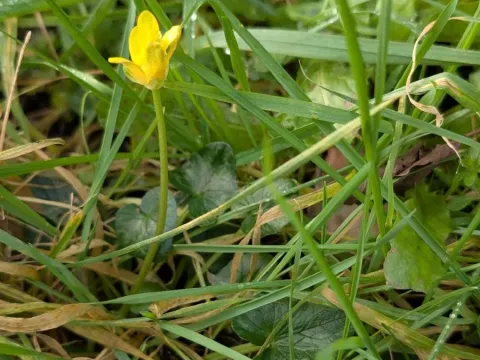
Lesser celandine
Ficaria verna
Lesser celandine is an ephemeral plant, which means its reproduction in cultivation is primarily vegetative, through the division of tubers or rhizomes. The optimal time for planting or transplanting is immediately after the flowering period ends, when the plant enters dormancy.
What the section contains
Lesser celandine
Seed propagation is rarely used as the seeds require stratification and exhibit slow germination. Seeds should be sown in autumn in open ground or trays to ensure the natural cooling cycle required for successful development.
Planting depth should be between 3 and 5 cm depending on soil texture. It is vital to provide loose soil conditions, allowing the roots to establish easily and facilitating spring emergence.
When dividing, tuberous roots are separated from the parent plant and replanted immediately. A spacing of 15–20 cm between specimens is recommended to provide sufficient space for growth.
The plant spreads rapidly thanks to the formation of bulbils in the leaf axils, which root easily upon contact with moist soil, allowing it to cover large areas quickly.
Lesser celandine belongs to the family Ranunculaceae and is a typical plant of the temperate regions of Eurasia. In nature, it prefers moist, shady woodlands, stream banks, and floodplains.
Successful cultivation requires fertile, humus-rich soil with a neutral to slightly acidic pH. The plant does not tolerate waterlogging during the winter, so good drainage is essential for survival.
The plant requires full light only during its short active vegetative phase in early spring. Once the above-ground parts die back in early summer, the light intensity is irrelevant as the plant enters dormancy.
Moisture availability is a critical factor for development. During dry early spring weather, moderate watering is necessary to maintain leaf turgor until the plant transitions to the dormant phase.
It possesses high cold hardiness, allowing it to withstand significant temperature drops, which is characteristic of its natural habitat within the forest zone.
Economic use of Lesser celandine is limited as the plant contains toxic compounds (protoanemonin) when fresh, which break down only after thermal processing or thorough drying.
In traditional herbalism, young leaves gathered before flowering are used for their high vitamin C content, historically serving as an antiscorbutic remedy, though precise dosage is required.
In ornamental horticulture, yield is evaluated by the density of the foliage mat and the number of flowers per square meter. Well-established clumps provide an early spring display in April and May.
While biomass production is relatively low, it serves as a vital early-season nectar source for pollinators emerging immediately after the winter season.
Commercial harvesting is constrained by the plant's biological cycle, as the above-ground biomass disappears rapidly, limiting the collection window to a short period of 2–3 weeks.
Lesser celandine demonstrates high resilience to most agricultural diseases due to its short life cycle. However, high humidity and poor ventilation can lead to fungal infections.
Common pathogens include powdery mildew, which appears as a white coating on the leaves, and various types of rot that affect the root system if the soil remains excessively wet.
Pests rarely cause critical damage due to the plant's early appearance. However, slugs and snails can significantly damage succulent young leaves during damp weather, reducing the aesthetic appeal.
To combat fungal infections, gardeners should maintain proper soil moisture levels and use preventive fungicide treatments if plants are grown in dense clusters.
Chemical pesticide use is highly restricted because the plant can be consumed for its herbal properties; therefore, cultural and biological control methods are strictly preferred.