
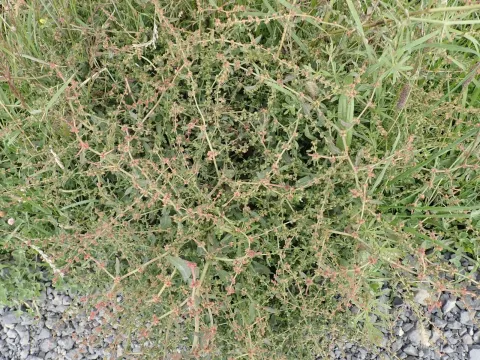
Fiddle dock
Rumex pulcher
Fiddle dock (Rumex pulcher) is a perennial member of the Polygonaceae family known for its resilience and deep taproot system. Propagation is primarily through seeds, which germinate optimally in spring when soil temperatures stabilize above 8 degrees Celsius.
What the section contains
Fiddle dock
Seeds should be sown at a shallow depth of 1–2 centimeters to ensure adequate moisture contact. Because the seeds are small, soil compaction after sowing is a necessary step to promote uniform germination across the field.
The growth cycle begins with a basal rosette of leaves, which becomes more robust during the first season. By the second year, the plant shifts energy into producing branching stems that can reach significant heights.
Field density management is essential for optimizing biomass production. While the species is competitive, maintaining appropriate row spacing helps in managing its spread and eases mechanical weeding operations.
The species exhibits a strong tendency for self-seeding, which makes it a persistent presence in agricultural landscapes. Its life cycle is long, providing year-round ground cover in favorable conditions.
Rumex pulcher thrives in full sun but demonstrates impressive shade tolerance compared to other forage species. It is highly adaptable, often colonizing compacted, heavy clay soils where other crops struggle to take root.
Climatic requirements are moderate, as the plant is well-suited for temperate regions. It exhibits high drought resistance thanks to its deep taproot, which allows it to access subsoil moisture during dry spells.
Regarding soil chemistry, the plant prefers neutral to slightly acidic conditions. It is remarkably tolerant of saline soils, making it a viable candidate for land restoration projects in challenging environments.
Nutrient management should focus on balanced phosphorus and potassium levels to support root architecture. Excessive nitrogen fertilization may lead to rapid leaf growth, potentially weakening the plant's structural integrity.
Aeration of the soil through regular mechanical intervention is beneficial in the early growth stages. This reduces the risk of waterlogging and promotes deep rooting, which is the key to the plant's survival.
Insect pests, specifically the dock leaf beetle, can cause severe defoliation during peak summer months. Such damage reduces the plant's photosynthetic capacity and can stunt overall development.
Fungal diseases like rust and various leaf spot pathogens are common in humid conditions. These infections often spread rapidly if there is insufficient air movement between plants in a dense stand.
Soil-borne nematodes can pose a threat to the root system, causing yellowing of leaves and reduced vigor. Crop rotation strategies are essential to break the life cycle of these underground pests.
Integrated pest management, including the removal of infected debris, is the best strategy for control. Avoiding excessive irrigation helps prevent the development of root rot and other moisture-related diseases.
Field sanitation remains the primary defense against systemic infections. Keeping the surrounding area clear of common weed hosts also limits the migration of pests onto the dock crop.