
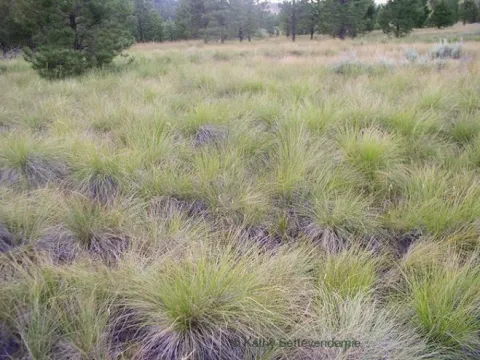
Western needlegrass
Stipa occidentalis
Western needlegrass (Stipa occidentalis) belongs to the Poaceae family and is a robust perennial grass native to the mountain ranges and arid regions of western North America. It is highly valued for its ability to thrive in challenging, nutrient-poor environments.
What the section contains
Western needlegrass
The plant grows in dense bunches, forming a thick root system that is essential for soil stability. Its leaves are narrow, typically folded or rolled, which significantly reduces water loss and allows the grass to survive extended drought periods during the summer.
Regarding soil requirements, Western needlegrass flourishes in well-drained, sandy, or rocky soils. It is highly intolerant of waterlogged conditions and heavy clay soils, which can lead to rapid root rot and overall plant decline in a short timeframe.
Climatically, this grass is well-adapted to high-altitude environments characterized by short growing seasons and cold winters. It requires ample sunlight to reach its full potential, making it unsuitable for shaded or dense woodland understory habitats.
The main agricultural use for Western needlegrass is soil erosion control and re-vegetation of disturbed lands. While it provides early forage, farmers must be aware that the needle-like awns of the seeds can cause irritation to the mouths and eyes of grazing livestock.
Rust fungi are the primary pathogens for Western needlegrass, often appearing during warm, humid weather. These fungi impair the photosynthetic capacity of the leaves, resulting in stunted growth and lower biomass production.
Insect pests include various species of grasshoppers, which can cause significant defoliation if left unchecked. Aphids also pose a threat by colonizing the tender parts of the stems, especially during the spring growth flush.
Effective management requires rotational grazing strategies to prevent the overgrazing of sensitive patches. Maintaining a healthy stand density is the best natural defense against invasive weeds and pest infestations.
While chemical pesticides are rarely necessary, integrated pest management (IPM) practices should focus on maintaining natural biodiversity. Encourage predatory insects that feed on aphids and other small pests in the grassland ecosystem.
To prevent disease outbreaks, avoid excessive irrigation and nitrogen application. These practices encourage succulent, fast growth that is more susceptible to both pathogenic fungi and sucking insect attacks.