
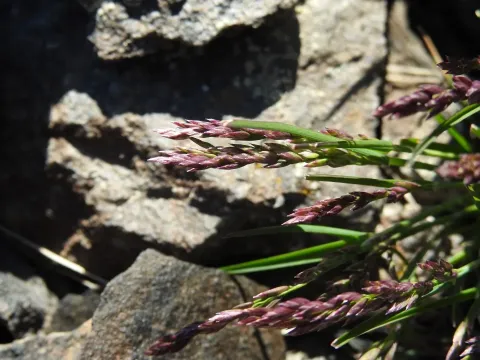
Wavy meadow-grass
Poa laxa
Wavy meadow-grass (Poa laxa) is a perennial grass species in the family Poaceae. It is a strictly alpine plant naturally distributed across high-altitude regions of Europe and North America, where it thrives in rocky habitats.
What the section contains
Wavy meadow-grass
The plant requires cool, humid climatic conditions and avoids high temperatures. It typically grows in mineral-rich, stony soils with excellent drainage, showing a remarkable adaptation to environments where other vegetation fails.
Botanically, it is characterized by its small size, usually reaching up to 20 centimeters. It forms dense, wavy-leaved tufts that are structurally adapted to minimize transpiration during extreme mountain weather.
Cultivation of Poa laxa requires a niche environment. It is not suitable for lowland agriculture due to its sensitivity to drought and competing faster-growing meadow grasses. It is strictly an alpine or sub-alpine specialized crop.
Key agrotechnical practices involve careful site selection. The soil must be poor in excessive nitrogen to prevent overgrown, weak growth, as this species has evolved to survive in nutrient-limited environments.
The primary use of Wavy meadow-grass is in environmental engineering. Its root system is exceptionally effective at stabilizing soil on mountain slopes, preventing both water and wind-induced erosion.
It provides grazing value in alpine pastures. Although its total biomass yield is low compared to commercial forage crops, its presence in high-altitude pastures significantly contributes to the dietary diversity of grazing livestock.
Harvesting for seed production is challenging due to the uneven maturation of the panicles. Seed collection usually requires hand-harvesting or specialized small-scale mechanical methods in alpine research stations.
There is no industrial harvest of this grass for fodder production because of the small yield per hectare. Instead, management focuses on maintaining the health of the sod layer in conservation projects.
Threats to the plant include invasive lowland species and climate change impacts. Proper site management involves periodic monitoring of vegetation competition to ensure the long-term survival of the Poa laxa stand.