
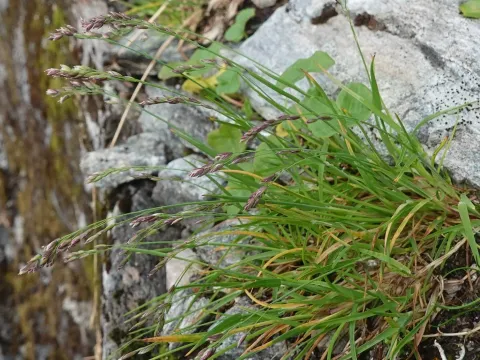
Wavy meadow grass
Poa flexuosa
Wavy meadow grass (Poa flexuosa) is a perennial grass species belonging to the Poaceae family. It is natively distributed across the high latitudes of the Northern Hemisphere, predominantly found in arctic and alpine environments where temperature fluctuations are extreme and the growing season is significantly limited.
What the section contains
Wavy meadow grass
Botanically, the plant is distinguished by its characteristic wavy or bent stems and narrow leaf blades that help reduce transpiration. The plant typically reaches heights between 10 and 30 centimeters, producing a loose, open panicle inflorescence that is well-adapted to surviving the heavy snow loads and harsh winds of northern regions.
The ecological requirements of Poa flexuosa center on well-drained, nutrient-poor, and stony substrates. It is highly intolerant of waterlogging or compacted soils, preferring environments with high drainage capacity such as alpine meadows, rocky screes, and tundra slopes where it maintains structural stability throughout the winter.
Regarding climate adaptation, this species thrives in low-temperature regimes. It has developed mechanisms to initiate growth immediately upon snowmelt, utilizing the short burst of solar radiation in arctic regions to complete its reproductive cycle before the return of frost, making it a highly resilient species.
From a forage management perspective, wavy meadow grass is highly valued for its nutritional profile in early development stages. While its total biomass yield is low compared to lowland grasses, its extreme hardiness makes it an important genetic resource for breeding high-latitude forage crops suited for extensive grazing systems.