
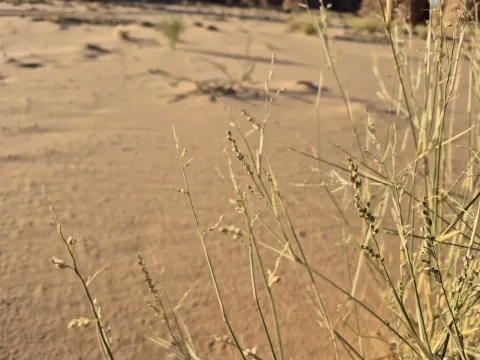
Bulrush millet
Panicum turgidum
Bulrush millet is a classic xerophyte, and its growth cycle is closely linked to the short-term moisture availability in arid zones. Sowing is typically carried out immediately after the first seasonal rains, once the soil temperature is warm enough to trigger seed germination for grasses.
What the section contains
Bulrush millet
In its natural habitat, the plant regenerates spontaneously from seeds when conditions allow. For agricultural cultivation, precise control over seeding depth is required; seeds must be planted shallowly to ensure rapid contact with moisture and sufficient energy for early development.
The optimal temperature range for seed germination is between 25 and 30 degrees Celsius. Consistent warmth is essential, as the species is highly sensitive to late frosts during its early growth stage, a common risk factor in semi-desert climates.
The speed of seedling development during the first few days is heavily dependent on soil moisture levels in the top layer. In agronomic practice, soil rolling after sowing is highly recommended to improve capillary moisture transport to the seeds.
The root system of the plant develops aggressively, allowing it to become independent of surface moisture very quickly. This trait makes it a highly promising candidate for the stabilization of degraded lands and soil reclamation projects in dry regions.
Panicum turgidum belongs to the Poaceae family and is a perennial herb characterized by an exceptionally robust root system. It is uniquely adapted to survive the extreme conditions of arid and semi-arid regions throughout North Africa and Western Asia.
The plant thrives in sandy, rocky, or loamy-sand soils that are generally low in organic matter. It displays remarkable tolerance to salinity, allowing for successful cultivation on land that would be deemed unsuitable for most other agricultural crops.
The primary climatic requirement is high solar radiation combined with minimal rainfall. The species can remain viable during prolonged drought by entering a state of dormancy, quickly recovering its metabolic activity as soon as moisture becomes available.
It is not demanding in terms of mineral fertilizers, as it has evolved to survive in nutrient-poor environments. However, minimal, controlled doses of nitrogen may be used in nurseries to stimulate vegetative mass production.
The most critical requirement for successful growth is the avoidance of waterlogging. Bulrush millet does not tolerate excess moisture in the root zone, which can lead to the development of root rot in high-humidity conditions.
Agricultural use of Panicum turgidum is primarily focused on the creation of pasture lands and the fixation of shifting sands. While its biomass yield is modest compared to traditional forage grasses, it remains exceptionally stable under desert conditions.
During favorable years, the crop can withstand multiple cuts, with the nutritional value of the hay remaining high enough for camels, sheep, and goats. The plant is valued for its ability to keep its tissues green even during periods of intense drought.
Seed productivity of Panicum turgidum is a key metric for evaluating success in breeding and selection programs. In wild ecosystems, seeds are wind-dispersed, ensuring natural population replenishment.
Optimizing agronomy with occasional irrigation can increase dry matter output by 20–30 percent. However, the high costs associated with watering in its native range mean that such investments are usually only viable for specialized land management goals.
Its use as a green manure helps enrich lightweight soils with organic matter, although the decomposition of plant residues is generally slow due to their high structural rigidity and woody nature of the stems.
Locusts are the primary pests for this crop and can cause significant damage to the leaf apparatus during periods of mass outbreaks. Effective control requires regular population monitoring in adjacent steppe regions.
During periods of abnormal rainfall, high humidity can trigger outbreaks of powdery mildew or rust. These diseases rarely kill an entire plantation but can significantly degrade the quality and palatability of the green fodder.
Root systems may be attacked by soil-borne nematodes, particularly when the crop is grown in monoculture over extended periods. Implementing crop rotation with non-grass species is the recommended strategy for prevention.
Overgrazing by livestock is a major threat, as it can cause damage to the rhizomes and severely impair the plant's natural regeneration capacity. Restricting animal access during active growth phases is essential for stand preservation.
Rodents may cause damage by gnawing on the bases of the stems to reach moisture, a behavior that becomes common during extreme droughts when other vegetation sources have withered away.
Green mass harvesting is conducted by mowing during the late tillering or early jointing phase, before the stems begin to lignify. Timely harvesting is crucial for forage quality, as the plant becomes excessively fibrous and less palatable as it matures.
For seed collection, direct combining is the standard method, performed once the grain reaches physiological maturity. Because the inflorescences often ripen unevenly, harvesting may need to be carried out in multiple passes.
Harvested mass must be dried quickly in the sun to lock in nutrients. Under unfavorable weather conditions, swath-drying may be necessary to prevent the material from rotting while on the ground.
Stored hay must be protected from rainfall, as any moisture accumulation in the bales promotes mold and fungal growth. Using shelters or protective covers prevents the degradation of the feed supply.
When processing seeds, it is essential to conduct preliminary cleaning to remove contaminants and sand that are frequently collected along with the low-growing foliage. The use of mechanical separators is standard for reaching seed-grade quality.