
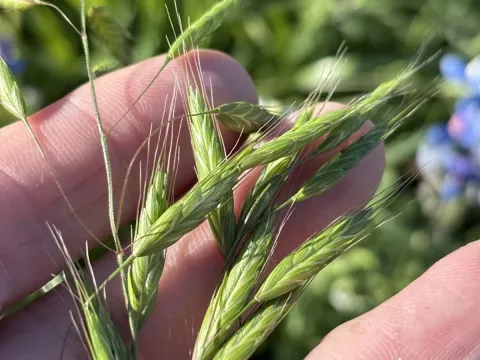
Japanese brome
Bromus japonicus
Japanese brome is an annual grass typically sown in early spring or autumn, depending on regional climatic patterns. The seed should be shallowly planted at a depth of 1-2 cm, as deep burial significantly reduces germination rates and seedling vigor due to the small size of the seeds.
What the section contains
Japanese brome
Precision planting using grain drills is recommended to achieve an even distribution of plants, which is crucial for suppressing weeds. A uniform plant density helps create a dense canopy, allowing the crop to dominate the soil surface effectively from the early stages of development.
Rolling the field after sowing is a vital agronomic practice that improves seed-to-soil contact. This step ensures that seeds are surrounded by soil particles, which helps retain moisture around the embryo and increases the rate of uniform emergence across the entire field.
If being incorporated into grass-legume mixtures, the seeding rate of Japanese brome must be carefully balanced to prevent it from outcompeting other desirable species. Proper management of these mixtures ensures high-quality forage throughout the growing season for livestock operations.
Post-emergence monitoring is essential to assess the success of the establishment phase. If patches appear due to environmental stress or poor sowing, corrective seeding might be needed, though the species is generally resilient and capable of filling gaps through natural tillering.
Belonging to the Poaceae family, Japanese brome shows a strong preference for well-drained, fertile soils. It thrives best in loam or sandy-loam environments with a neutral to slightly acidic pH, which provides optimal conditions for nutrient uptake and overall plant health.
The plant is known for its high adaptability to temperature fluctuations and moderate drought tolerance, making it a reliable choice for semi-arid grazing lands. It initiates growth early in the spring, leveraging cool-season moisture before temperatures rise significantly.
Nutrient management focuses on nitrogen applications to boost vegetative biomass production, which is essential for forage yields. Phosphorous and potassium levels should be monitored through soil testing to ensure the roots and stems are sturdy enough to support the harvestable mass.
Adequate sunlight is critical for this heliophilic grass; thus, it is not suitable for shady areas. Open fields provide the necessary light energy for photosynthesis and proper development of the inflorescences, which are essential if the goal is seed production or natural reseeding.
The species avoids waterlogged conditions, making proper soil drainage a priority. It is essential to avoid planting in heavy clay soils or depressions where standing water accumulates, as this will lead to root rot and diminished vigor in the crop stand.
Fungal diseases such as rusts and powdery mildew are the primary threats to Japanese brome, especially in humid and stagnant air conditions. Proactive monitoring and the application of fungicides are necessary when environmental conditions favor the development of these pathogens.
Pests like cereal aphids can cause significant damage by feeding on the sap, which weakens the plants and lowers their nutritional quality. Integrated pest management (IPM) practices, including the use of targeted insecticides, are recommended to maintain healthy and productive stands.
Competition from invasive weeds can be fierce during the establishment year. A combination of crop rotation and selective herbicides provides the best results for controlling broadleaf weeds and unwanted grasses that threaten to reduce the quality of the harvest.
Improper seed storage can lead to decreased viability and the introduction of weeds or pathogens into the fields. Using certified, clean seed lots is a foundational practice to protect the long-term productivity and health of the forage crop.
Monitoring the field for stress signs, such as yellowing leaves or stunted growth, allows the farmer to address nutrient deficiencies or pest outbreaks early. A systematic approach to field maintenance reduces the need for heavy chemical intervention and promotes a balanced ecosystem.