
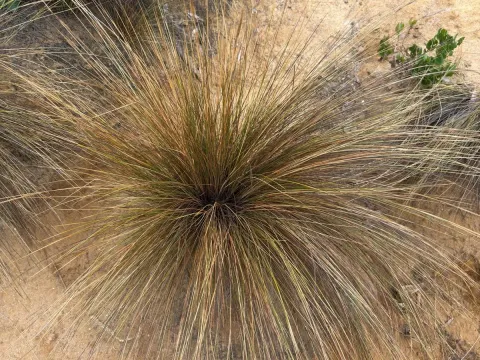
Austrostipa
Austrostipa
Austrostipa is a genus of perennial grasses belonging to the family Poaceae. Formerly included within the genus Stipa, these plants were reclassified based on molecular data and now encompass about 60 distinct species native primarily to Australia.
What the section contains
 Austrostipa aristiglumis
Austrostipa aristiglumis
Austrostipa aristiglumis
 Austrostipa bigeniculata
Austrostipa bigeniculata
Austrostipa bigeniculata
 Austrostipa mollis
Austrostipa pubescens
Austrostipa pubescens
Austrostipa mollis
Austrostipa mollis
Austrostipa pubescens
Austrostipa pubescens
 Austrostipa ramosissima
Austrostipa ramosissima
Austrostipa ramosissima
 Austrostipa semibarbata
Austrostipa semibarbata
Austrostipa semibarbata
 Austrostipa setacea
Austrostipa setacea
Austrostipa setacea
 Austrostipa tenuifolia
Austrostipa tenuifolia
Austrostipa tenuifolia
 Austrostipa variabilis
Austrostipa variabilis
Austrostipa variabilis
 Elegant Feather Grass
Austrostipa elegantissima
Elegant Feather Grass
Austrostipa elegantissima
 Flat-awned Speargrass
Austrostipa platychaeta
Flat-awned Speargrass
Austrostipa platychaeta
 Rough speargrass
Austrostipa scabra
Rough speargrass
Austrostipa scabra
 Whorled speargrass
Austrostipa verticillata
Whorled speargrass
Austrostipa verticillata
Austrostipa
The plant is highly adapted to arid environments, possessing a deep and robust root system. This biological trait allows it to thrive in poor soils and maintain structural integrity, making it valuable for soil stabilization and anti-erosion projects.
Optimal growth requires full sun exposure and well-drained soil. Austrostipa is extremely sensitive to waterlogged conditions, so it performs best in sandy or loamy soils where moisture does not accumulate in the root zone.
Climate requirements include warm growing seasons and protection from extreme frost. The plant is well-suited for temperate to semi-arid zones, where its ability to form dense tussocks helps conserve soil moisture.
Cultivation requires minimal intervention once established, but initial weed control during the seedling stage is critical to ensure the crop becomes properly anchored in the target area.
In agricultural settings, Austrostipa serves as a forage crop, although its value is highly dependent on the stage of harvest. Early-season biomass is most nutritious, while mature stems become hard and unpalatable.
Beyond agricultural forage, the plant is widely appreciated in landscaping and ecological restoration. Its decorative seed heads provide year-round interest and habitat for beneficial insects.
Management for high forage quality involves rotational grazing or strategic mowing before the seeds set. This keeps the plants in a vegetative state, preventing the accumulation of indigestible silica and fiber.
Yield stability is maintained by managing grazing pressure. Overgrazing is a significant risk that can destroy the dense clumps, leading to soil degradation and colonization by invasive species.
High seed yield capacity makes it relatively simple to propagate the species on large scales. Proper seed cleaning and testing ensure high germination rates for future planting seasons.
The primary threats to Austrostipa populations are fungal pathogens that thrive in humid or stagnant air conditions. Powdery mildew and various leaf rusts can significantly decrease biomass quality and total yield.
Pests such as aphids and spider mites are common during dry periods when the plant's metabolic processes slow down. Integrated pest management strategies are essential to keep these populations under control.
Invasive species represent a major ecological threat to established stands. Competition for space and nutrients can weaken the Austrostipa, making it more vulnerable to secondary infections.
Improper pasture management remains the leading cause of loss. Maintaining an appropriate grazing schedule is vital to allow the root reserves to recover between cycles of forage utilization.
Monitoring for signs of root rot is also important, especially if the area has experienced unexpected flooding. Regular field assessments allow for the application of preventative measures to maintain stand longevity.