
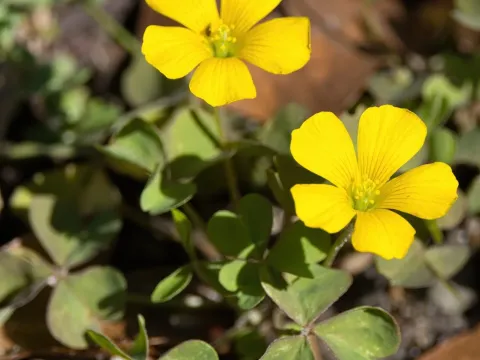
Dillen's oxalis
Oxalis dillenii
Dillen's oxalis is a perennial herbaceous plant belonging to the Oxalidaceae family. Known for its distinct yellow flowers and clover-like trifoliate leaves, this species is frequently encountered as an aggressive weed in various agricultural and horticultural settings.
What the section contains
Dillen's oxalis
The plant reproduces primarily through seeds that are ejected forcefully from mature capsules upon mechanical disturbance. Germination usually begins in the spring once soil temperatures reach a suitable threshold, typically around 10–12 degrees Celsius, allowing the plant to establish early.
The biological cycle of Dillen's oxalis is characterized by high reproductive capacity. It can produce several generations of seeds within a single growing season, which makes it a persistent challenge for farmers seeking to maintain clean fields and optimized crop yields.
Its growth habit includes a well-developed root system, often featuring rhizomes or stolons that allow for efficient vegetative spread. This combination of sexual and asexual reproduction strategies contributes significantly to the plant's resilience against traditional manual removal methods.
From an agronomic perspective, understanding the developmental phases of Oxalis dillenii is crucial for timing interventions. Its ability to persist in the soil seed bank for several years necessitates long-term planning and consistent weed management practices.
Dillen's oxalis thrives in well-drained, loose soils with a neutral to slightly acidic pH. It demonstrates a high level of environmental plasticity, adapting well to a variety of light conditions ranging from full sun to partial shade, which allows it to colonize diverse landscapes.
Water requirements for this species are moderate, but it is sensitive to waterlogged soils, which can lead to root decay. Conversely, it shows remarkable tolerance to periodic drought, supported by its ability to store moisture within its succulent-like leaf structures.
Optimal growth occurs at temperatures between 18 and 25 degrees Celsius. While it is hardy in many climates, its active growth slows significantly when temperatures drop below 5 degrees, and the above-ground portions will die back during severe frost conditions.
Agricultural management requires deep tillage to bury seeds beyond their germination depth, though this must be balanced with the risks of soil erosion. Implementing competitive crop stands is also a highly effective strategy to suppress the development of this weed.
When dealing with heavy infestations, the use of selective herbicides is often necessary. Managing fertility to favor the main crop, rather than the weed, remains a core principle of maintaining a productive agricultural system in the presence of Oxalis dillenii.
Various rust fungi are known to affect Dillen's oxalis, often causing visible deformation of the foliage during periods of high humidity. While these pathogens can stress the plant, they rarely provide complete control of an established infestation in agricultural fields.
Aphids are the most common pests observed on this plant, as they feed on the sap of young buds and leaves. Their presence can sometimes vector secondary pathogens, though the impact of these pests on the plant’s survival is generally minor under field conditions.
Soil-dwelling nematodes can negatively impact the root system of Oxalis dillenii by causing gall formations. This biological interference can reduce the plant’s vigor and spread, acting as a natural check on its population density in certain ecosystems.
Phytosanitary concerns arise from the fact that Dillen's oxalis may host viruses that affect economically important crops. Regular monitoring and removal of infected areas are recommended to prevent the spread of diseases from the weed to cultivated plants.
Integrated pest management strategies focusing on physical and chemical control remain the standard approach for dealing with Dillen's oxalis. Efforts are typically directed at population eradication rather than specific management of the weed’s own pests and diseases.