
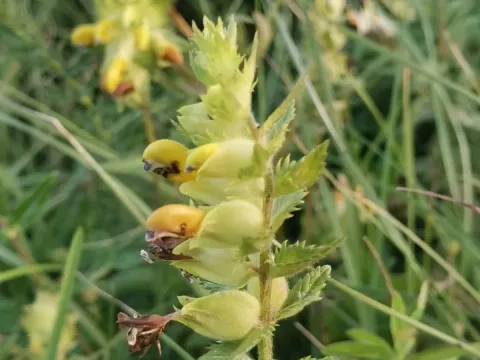
Rhinanthus rumelicus
Rhinanthus rumelicus
Rhinanthus rumelicus is an annual herbaceous plant belonging to the Orobanchaceae family. It is recognized as a facultative hemi-parasite, meaning it derives water and nutrients by attaching its roots to the roots of neighboring grasses and herbs via specialized structures called haustoria.
What the section contains
Rhinanthus rumelicus
Native primarily to the Balkan Peninsula and regions of Southeastern Europe, this species thrives in open meadow habitats. It prefers moderately fertile, well-drained soils that support a diverse variety of grass species, which serve as essential hosts for its development.
The plant demonstrates a strong preference for sunny locations. It requires ample light to successfully complete its life cycle and is rarely found in densely shaded environments where competition for light is intense and host grass density is too low.
Cultivation or management of meadows containing this species requires a balance of moderate grazing or periodic mowing. This prevents the dominance of overly aggressive grass species that could otherwise crowd out the hemi-parasitic Rhinanthus.
Morphologically, it features erect stems growing up to 50 cm, opposite leaves, and distinctive yellow, bilabiate flowers arranged in terminal spikes. Its seeds are enclosed in papery capsules and are typically dispersed by wind, ensuring the population spreads within suitable habitats.
The primary threat to Rhinanthus rumelicus is the intensification of agricultural land management. High levels of nitrogen fertilizers disproportionately benefit non-host grasses, leading to the rapid decline of the hemi-parasite.
Fungal infections, particularly mildews, pose a risk during periods of high humidity. These pathogens can weaken the plant and reduce its physiological capacity to attach to host roots, thereby stunting its overall growth.
Insect pests that target floral parts and developing seeds are known to impact natural regeneration. In some areas, these insects can significantly reduce the annual seed bank if left unchecked by natural predators.
Overgrazing in late spring and early summer represents a major physical risk, as animals may damage the fragile stems of young plants before they reach the stage of seed dispersal, effectively cutting the reproductive cycle.
Fragmentation of natural habitats and the conversion of traditional hay meadows into arable fields drastically reduce the available space for this species, as it relies on a diverse community of hosts to thrive.