
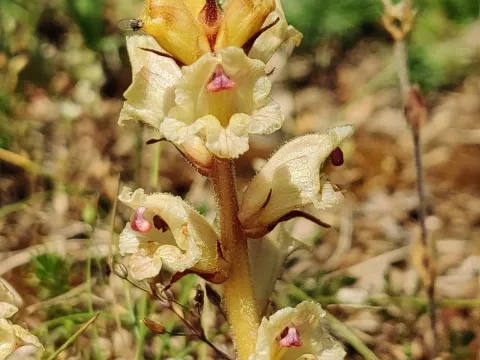
Thyme broomrape
Orobanche alba
Thyme broomrape (Orobanche alba) is a root parasitic plant belonging to the Orobanchaceae family. Lacking chlorophyll, it cannot perform photosynthesis and relies entirely on a host plant, attaching its roots to the host's vascular system through specialized structures called haustoria.
What the section contains
Thyme broomrape
The species is native to large parts of Europe, the Caucasus, and Central Asia. It thrives in dry, sunny environments, particularly in steppes and limestone grasslands where it parasitizes various species of the Lamiaceae family, most notably thyme (Thymus species).
Botanically, Orobanche alba is characterized by a glandular-pubescent stem that can be reddish, purplish, or yellowish, bearing scale-like leaves. It emerges from the ground only during the flowering stage, producing dense inflorescences that release thousands of microscopic seeds.
The seeds of Thyme broomrape are dormant in the soil for years and are highly sensitive to specific chemical signals released by host roots. Once these signals trigger germination, the radicle must immediately find a host root to survive, otherwise the seedling dies within days.
In agriculture, this plant is considered a problematic weed rather than a crop. Effective management requires long-term rotation strategies using non-host crops to prevent the accumulation of its seed bank in the soil, which is the primary challenge for field protection.
As a parasite, Orobanche alba represents a significant threat to agricultural productivity by diverting water, sugars, and nutrients from the host plant. This severely weakens the crop and reduces the overall yield quality and quantity, especially under stressful environmental conditions.
Natural suppression occurs through the activity of specialized insects, such as the Phytomyza flies, which act as biological control agents by consuming the internal tissues of the broomrape flower stalks, thereby preventing successful seed set and limiting population growth.
Certain fungal pathogens, including species of Fusarium, have been observed infecting Orobanche species. Researchers are investigating these pathogens to develop safe biocontrol measures that can target the parasite without harming the surrounding agricultural crops.
Manual control, although labor-intensive, remains the most reliable method for small infestations. It involves removing the broomrape stalks before they produce seeds to break the reproductive cycle and reduce the infestation pressure for the following seasons.
Preventative measures include the rigorous inspection of farm machinery and seeds to prevent the spread of broomrape to clean fields. Given the difficulty of selective chemical herbicides, integrated pest management (IPM) is the recommended approach for containment.