
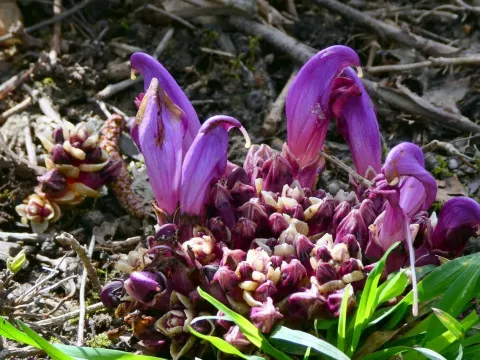
Toothwort
Lathraea
Toothwort (genus Lathraea) is a parasitic plant belonging to the Orobanchaceae family. It is not classified as an agricultural crop but rather as an obligate holoparasite, meaning it lacks chlorophyll and cannot perform photosynthesis to sustain itself.
What the section contains


Toothwort
The plant thrives by attaching its specialized root structures, known as haustoria, to the roots of host trees and shrubs. Common hosts include hazel, alder, beech, and poplar, which provide the parasite with the necessary minerals, water, and carbohydrates.
The geographic distribution of Lathraea spans the temperate regions of Europe and Asia. It requires specific ecological niches, typically damp, shaded woodland environments where the soil is rich in organic matter and remains moist throughout the year.
Botanically, it is a perennial herb characterized by a stout, creeping rhizome covered in fleshy, scale-like leaves. Its lifecycle is unique: it spends the majority of the year underground, only emerging in early spring to produce showy racemes of flowers.
There is no agricultural practice for cultivating toothwort, as it holds no value for food or industrial production. In silviculture, it is regarded as a natural botanical component of forest ecosystems rather than a crop that requires management.
As a highly adapted parasite, the toothwort is relatively resilient within its natural forest habitat. However, it faces significant threats from large-scale deforestation and changes in land use that dry out or degrade the moisture-rich habitats it requires to survive.
There are no major insect pests or diseases that target toothwort specifically. Its biggest biological challenge is the availability of suitable host trees; if the local host population declines, the parasite cannot complete its reproductive cycle.