
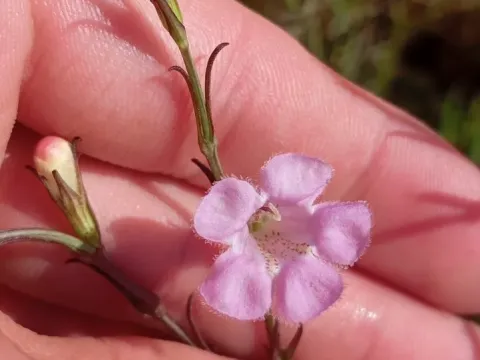
Tomanthera
Tomanthera
The genus Tomanthera, belonging to the Orobanchaceae family, comprises specialized hemiparasitic herbaceous plants. In an agricultural context, this is not a cultivated crop; rather, it is a wild botanical entity that relies on intricate biological interactions to complete its life cycle.
What the section contains

Tomanthera
Propagation occurs through seeds that possess a unique dormancy mechanism. These seeds will typically germinate only upon detecting specific chemical signals, known as strigolactones, released by the root systems of compatible host plants in their native prairie environment.
The growth cycle is synchronized with the seasonal development of native grasses. Following spring germination, the young plant must quickly develop a haustorium—a specialized structure that penetrates the host root—to access nutrients and water required for its survival.
Given its dependency on a living host, traditional sowing techniques used for agronomic crops are inapplicable. The plant's existence is entirely dictated by the ecological health of its surrounding plant community, making it a subject of conservation biology rather than commercial cultivation.
Research into the germination physiology of Tomanthera provides essential insights into the complex relationships within ecosystems. Understanding these processes is vital for ecological restoration efforts, as the plant serves as an indicator of habitat health in its native range.
Tomanthera requires highly specific environmental conditions to thrive. It is natively found in the tallgrass prairies of North America, where the presence of its host plants is consistent and the soil chemistry supports the formation of haustorial connections.
The substrate must be well-drained and relatively rich in organic matter. While the plant can tolerate various soil textures, the fundamental requirement is a consistent presence of the host species within the immediate rhizosphere to ensure the parasite can establish its connection.
Exposure to full sunlight is crucial for the plant's development. As a hemiparasite that still conducts some photosynthesis, it requires high light levels and cannot survive under the dense canopy of forests or in heavily shaded areas where its host grasses might struggle as well.
Climate plays a significant role in the plant's distribution. It is adapted to the seasonal rainfall patterns of the central and southeastern United States, where the cycle of wet springs and warmer summers aligns with the growth spurts of its primary hosts.
Management of the habitat is essential. This includes maintaining open prairie landscapes. If the area becomes overgrown with woody shrubs or invasive weeds, the specific host plants and the parasitic Tomanthera itself are likely to be displaced, leading to population decline.
The primary threat to the genus is the degradation and loss of native prairie ecosystems. Conversion of land to agricultural fields or urban development disrupts the essential host-parasite relationship, effectively eradicating the species from the affected area.
Invasive species represent a significant ecological threat. Non-native plants often alter the soil composition and compete for resources, forcing out the native grasses that Tomanthera relies upon for sustenance, thereby breaking the survival chain for the hemiparasite.
Changes in natural disturbance regimes, particularly the suppression of fire, negatively impact these plants. Historically, periodic wildfires cleared competition and stimulated the germination of prairie seeds; the loss of this cycle contributes to the increasing rarity of the genus.
Diseases that affect the health of the host grasses indirectly harm Tomanthera. Because the parasite is physiologically linked to the host's vascular system, any pathogen that inhibits the host's growth or reduces its vigor directly impacts the parasite's access to resources.
Fragmentation of habitat prevents the natural dispersal of seeds and reduces the genetic diversity of isolated Tomanthera populations. This makes the remaining plants more vulnerable to environmental stresses and long-term climate changes that the species might otherwise be able to adapt to.