
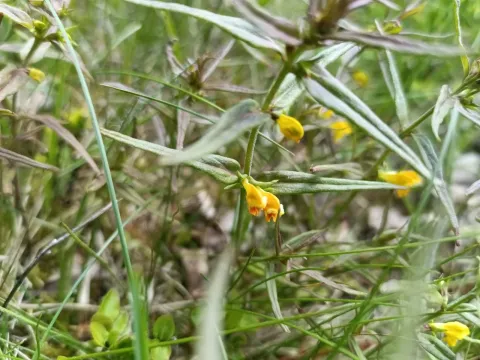
Wood cow-wheat
Melampyrum sylvaticum
Wood cow-wheat (Melampyrum sylvaticum) belongs to the Orobanchaceae family. It is an annual herbaceous plant characterized by a hemiparasitic life strategy, where it extracts nutrients from host plants via specialized root structures.
What the section contains
Wood cow-wheat
The plant is native to European forests, where it thrives in shaded or semi-shaded environments. It is frequently found in coniferous, deciduous, and mixed forest types with sufficient ground moisture.
The cultural success of this species depends heavily on the presence of appropriate host plants. Its root system, known as haustoria, connects to the roots of nearby plants to absorb water and minerals.
Soil requirements include moderate acidity and high organic content, which is typical for forest floors. Constant humidity is crucial for the development of the seedlings during the early stages of growth.
In terms of climate, Wood cow-wheat is well-adapted to temperate regions. It exhibits high tolerance to cooler conditions and low-light environments typical of mature forest ecosystems.
Like many forest species, Wood cow-wheat is susceptible to various fungal pathogens that thrive in high-humidity microclimates. These diseases can lead to tissue decay if airflow is insufficient.
While not a target for industrial agriculture, the plant can be damaged by generalist insect herbivores found within its natural forest habitat.
Environmental stress, such as soil compaction or drainage of forest wetlands, significantly reduces the population viability of this species in its natural range.
Competition from more aggressive, invasive plant species can hinder the development of Wood cow-wheat, especially in disturbed forest clearings.
Due to its niche lifestyle as a hemiparasite, the health of this plant is intrinsically linked to the biodiversity and stability of the entire forest community surrounding it.