
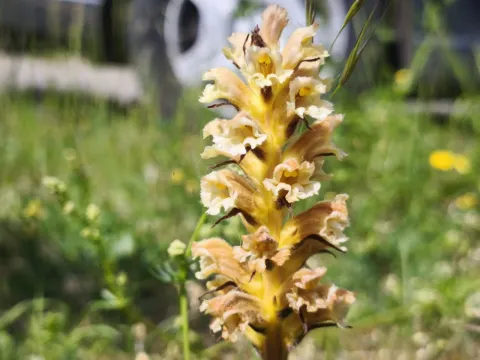
Yellow broomrape
Orobanche lutea
Yellow broomrape (Orobanche lutea) is an obligate root parasite belonging to the Orobanchaceae family. Being a holoparasite, it lacks chlorophyll and cannot perform photosynthesis, thus relying entirely on host plants for water, nutrients, and carbon compounds.
What the section contains
Yellow broomrape
The plant is native to Europe and Western Asia, commonly inhabiting calcareous soils, grasslands, and agricultural fields. It is specifically adapted to parasitize leguminous crops, making it a significant challenge for farmers specializing in forage and pulses.
The botanical structure consists of a single or branched stem, yellowish to reddish in color, typically growing 15 to 40 cm tall. The leaves are reduced to scale-like structures, and the flowers are arranged in a terminal inflorescence that emerges from the soil.
Its parasitic mechanism involves the formation of haustoria. Once the broomrape seeds detect root exudates from a host, they germinate and form these specialized structures that penetrate the host root tissue to establish a connection with the vascular system.
Reproduction is highly efficient, as a single broomrape plant can produce thousands of microscopic seeds. These seeds are characterized by extreme longevity, remaining viable in the soil for many years until a suitable host root is detected nearby.
Yellow broomrape poses a serious economic threat to legume cultivation, particularly affecting crops like alfalfa and clover. By draining host plants of essential nutrients, it stunts their growth, reduces biomass yield, and can ultimately lead to total crop failure.
The presence of broomrape induces physiological stress in host plants, making them more susceptible to drought and secondary pathogens. Infections by fungal diseases often occur at the sites where the parasite's haustoria have breached the host's root epidermis.
Management requires an integrated approach starting with long-term crop rotation. By avoiding leguminous crops for at least five to seven years, farmers can deplete the reservoir of broomrape seeds in the soil, as they require a host to complete their cycle.
Cultural practices such as deep plowing and the use of "trap crops" that stimulate seed germination without providing a suitable host can effectively reduce the seed bank. Maintaining field hygiene by cleaning equipment is vital to prevent the spread of seeds.
Chemical control remains difficult due to the physiological connection between the parasite and the host. Research continues into selective herbicides, but currently, preventive measures and rigorous field scouting during the broomrape flowering season remain the best defenses.