
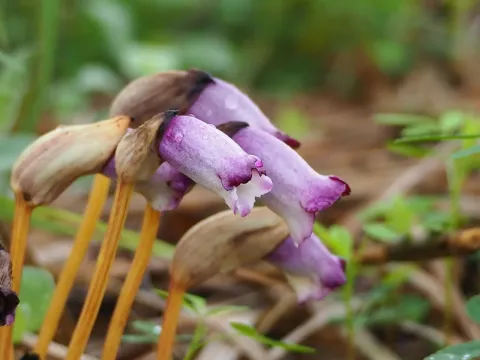
Aeginetia indica
Aeginetia indica
Aeginetia indica is a member of the Orobanchaceae family, commonly known as the broomrape family. It is an obligate root parasite that lacks chlorophyll, relying entirely on host plants for water, minerals, and carbon compounds through specialized haustoria.
What the section contains
Aeginetia indica
The native range of this species is extensive across tropical and subtropical Asia, including countries like India, China, and Japan. It typically inhabits moist, shaded areas and can become a significant agricultural pest in sugarcane and cereal fields.
Botanically, the plant is characterized by its reduced structure and high specialization. The main body of the plant is underground, consisting of a network that attaches to host roots, while the only visible parts are the stalks with distinctive tubular flowers.
The plant requires high humidity and well-drained but moist soil to complete its life cycle. The presence of specific chemical exudates from the host roots is essential for the germination of its microscopic seeds, which can remain dormant in the soil for several years.
While Aeginetia indica holds no agricultural value, it is of significant interest in botanical studies due to its highly specialized parasitic nature. In farming, it is strictly considered a destructive weed that drastically reduces yields in various industrial crops.
The primary threat posed by Aeginetia indica is its prolific seed production. A single mature plant can produce thousands of tiny, wind-dispersed seeds, making it extremely difficult to contain once established in a field or agricultural landscape.
Managing the parasite is challenging because it is hidden underground for most of its life cycle. By the time the flowers appear above ground, significant damage to the host's root system has often already occurred, reducing the crop's vigor and nutrient uptake.
Control strategies primarily focus on preventative measures, such as strict crop rotation and using trap crops that induce seed germination without providing a suitable host connection. Soil solarization and chemical treatments are also explored as management options.
There are currently no significant biological controls or widespread natural enemies that effectively manage populations of this parasite in agricultural settings, leaving farmers reliant on integrated pest management practices.
To minimize risks, farmers are advised to perform deep tillage after harvest and to ensure that agricultural machinery is cleaned thoroughly to prevent the movement of contaminated soil from infested to clean fields.