
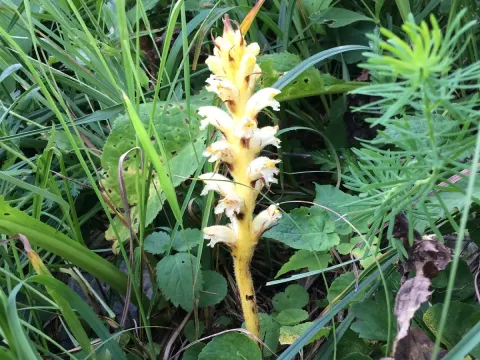
Aconite broomrape
Orobanche lycoctoni
Aconite broomrape (Orobanche lycoctoni) is a perennial herbaceous parasitic plant belonging to the Orobanchaceae family. It is a holoparasite, meaning it lacks chlorophyll entirely and relies completely on its host for nutrition.
What the section contains
Aconite broomrape
The biology of this species is strictly tied to its host plants, primarily within the genus Aconitum. By utilizing haustoria, the parasite penetrates the roots of the host and extracts essential water, minerals, and carbohydrates from the vascular system.
The plant grows as a fleshy, erect stem reaching 20 to 50 centimeters in height, featuring scale-like leaves. Its flowers form a dense spike, adapted for specific pollinators, and range in color depending on the environmental conditions and the specific host variety.
Its natural range is found primarily in temperate forest regions across Eurasia. It thrives in shaded, moist environments where host plants are abundant, which is essential for the germination of its microscopic, long-lived seeds.
While not a major commercial agricultural pest like other broomrape species, it can be a nuisance in wild-harvested medicinal plant plots or forest-adjacent agroecosystems where aconite is either cultivated or naturally present.
The germination of Aconite broomrape seeds is strictly dependent on chemical stimuli produced by the root systems of the host plant. Without the presence of these signals, seeds can remain dormant in the soil for over a decade.
Optimal environmental conditions involve high humidity and humus-rich soil. The plant is rarely found in dry, exposed agricultural fields, preferring the sheltered microclimates of forest floors and woodland edges.
The species prefers temperate climates with limited direct sunlight. Shaded conditions protect the succulent stems from rapid desiccation and support the longevity of the plant during its relatively short flowering period.
Management requires the removal of host plants (aconites) from the surrounding areas to prevent the parasite from establishing a foothold. Monitoring for host presence is key to preventing the spread of the parasite.
Preventative measures include cleaning equipment to avoid spreading tiny, dust-like seeds between sites, especially when working in areas where the parasite is known to exist.
Natural pathogens often affect the broomrape flower stalks, particularly fungal diseases that thrive in moist, cool conditions, potentially limiting the amount of mature seed released into the soil.
Insect pests that consume the succulent tissues of the stem and reproductive organs can significantly hinder the reproduction of the parasite, acting as a natural biological control agent.
The primary agricultural threat is the physiological stress placed on the host plant. By draining nutrients, the parasite causes stunted growth, reduced vitality, and occasionally the death of the infected aconite plant.
Mechanical control is the most effective approach: hand-pulling the stalks before they produce seeds prevents the population from growing. This is crucial for maintaining the health of medicinal plant collections.
Since the root connection is internal to the host, systemic chemical control is often impractical and ineffective, leaving cultural and mechanical interventions as the primary tools for management.