
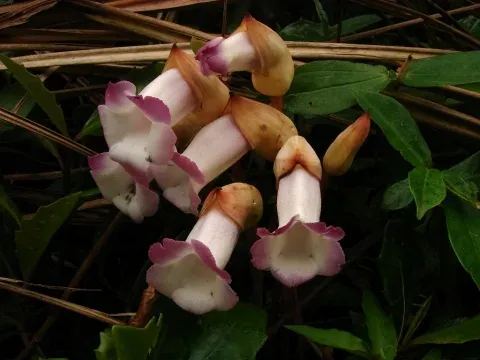
Aeginetia
Aeginetia
Aeginetia is a genus within the Orobanchaceae family, consisting of highly specialized obligate parasitic plants. These plants are achlorophyllous, meaning they lack chlorophyll and cannot perform photosynthesis, thus relying entirely on a host plant for their survival and reproductive energy.
What the section contains


Aeginetia
The origin and primary distribution of Aeginetia are concentrated in the tropical and subtropical regions of Asia. Countries such as India, China, and Vietnam are the most affected, where the environment perfectly suits the parasite's specific germination requirements in paddy fields and moist grasslands.
Botanically, Aeginetia is unique due to its root-parasitic nature. It uses specialized structures called haustoria to invade the host's root system. Most of the plant's life cycle occurs underground, with only the flowering stems emerging to disperse thousands of dust-like, wind-borne seeds.
The climate requirements for Aeginetia include high soil moisture and warm temperatures. These conditions are typical for rice-growing regions, where the plant thrives by tapping into the dense root networks of monocotyledonous crops, causing significant physiological stress to the host.
Agrotechnical management requires rigorous field monitoring and sanitation. Farmers are encouraged to use deep plowing, effective weed control in surrounding areas, and the introduction of trap crops that trigger seed germination without allowing the parasite to attach, thereby depleting the seed bank.
The primary threat posed by Aeginetia is the extreme reduction in host plant yield. By diverting vital sugars and nutrients from the host, the parasite weakens the crop, leading to stunted growth, nutrient deficiency symptoms, and in severe infestations, the complete collapse of the plantation.
Regarding pest and disease control, Aeginetia itself is often the target of integrated pest management (IPM) programs. Biological agents, specifically certain soil-borne fungi, are researched for their potential to inhibit the germination or survival of the parasite seeds before they can infect the primary crop.