
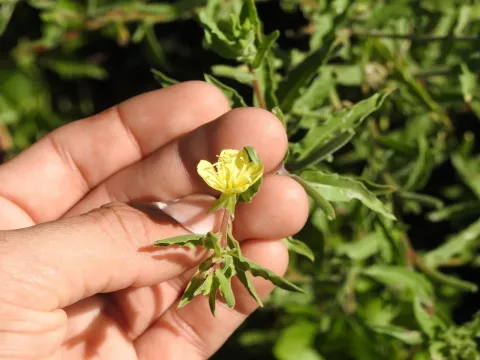
Oenothera indecora
Oenothera indecora
Oenothera indecora belongs to the Onagraceae family. It is an annual herbaceous plant increasingly recognized in agricultural sectors for its seeds, which are a concentrated source of high-value fatty acids and bioactive compounds.
What the section contains
Oenothera indecora
The optimal sowing time is in spring, once the soil temperature consistently reaches 10–12°C. The seeds exhibit good germination vigor, provided that the soil is properly prepared to ensure a favorable environment for seedling emergence.
Seeds should be sown at a shallow depth of 1–2 centimeters. Due to their extremely small size, they require excellent contact with moist soil, making precise depth control and post-sowing compaction essential for success.
For commercial production, row spacing is typically maintained between 30 and 45 centimeters. This spacing allows for the healthy development of leaf rosettes and provides sufficient room for the plant to produce robust flower stalks.
Sowing density must be carefully managed to prevent excessive competition between plants. As a light-loving species, Oenothera thrives in sunny conditions, and over-density can lead to stunted growth and reduced seed yield.
Oenothera indecora requires open, well-lit sites to reach its full potential. The crop is moderately drought-tolerant but necessitates adequate moisture during the critical phases of flowering and seed set to ensure high productivity.
The best soil types are light sandy or loamy soils with high aeration. The plant is sensitive to waterlogging and acidic soil conditions, making proper soil drainage a mandatory requirement for achieving a healthy and uniform stand.
The ideal soil pH range for this crop is between 6.0 and 7.0. Before sowing, the field must be thoroughly cleared of perennial weeds, as the young seedlings of Oenothera are susceptible to competition during the establishment phase.
Applying mineral fertilizers, particularly those rich in phosphorus and potassium, significantly improves the oil content of the seeds. Nitrogen applications should be carefully balanced to prevent excessive foliage growth at the expense of seed production.
Climatic requirements involve a stable, warm summer season. While the crop can tolerate minor temperature fluctuations, it is vital to avoid frost during the active growth and flowering phases to protect potential seed yields.
Fungal diseases are the primary threat to Oenothera, especially in regions with high humidity. Conditions such as powdery mildew and various leaf spot diseases can develop rapidly, potentially compromising plant health and yield quality.
Insect pests that target reproductive parts, such as flower buds and seed capsules, pose a significant risk. Meadow bugs and certain species of weevils can cause substantial damage if left unmanaged during the peak development season.
Implementing a sound crop rotation strategy is the most effective biological defense. It is recommended to avoid planting Oenothera on the same ground more than once every four years to prevent the buildup of soil-borne pathogens.
Integrated pest management, including the use of biological control agents and targeted applications of authorized insecticides, is necessary for maintaining crop health while adhering to modern environmental standards.
Regular field monitoring is a key agronomic practice. Early detection of disease outbreaks or pest presence allows for timely intervention, effectively safeguarding the crop and optimizing long-term production outcomes.
Harvesting should be conducted at full maturity, when seed capsules turn a distinct brown color. Since the seeds are prone to natural shedding, timing the harvest correctly is critical to preventing significant yield losses.
Direct combining is common when the crop matures evenly. Equipment must be precisely adjusted to minimize mechanical impact, as the tiny seeds can easily spill from the capsules if handled with excessive force during the threshing process.
In cases of uneven ripening, a two-phase harvesting method—mowing into windrows—is preferred. This allows the crop to finish maturing naturally, ensuring that the seeds reach optimal quality before the final collection.
Post-harvest handling requires immediate cleaning to remove plant debris, followed by efficient drying. Seed moisture content should be kept within safe thresholds for oilseeds to prevent degradation and fungal growth during storage.
Storage should take place in dry, well-ventilated facilities. Storing the seeds in proper containers protects them from moisture and pests, ensuring that their valuable oil content and germination capacity remain intact until processing or future sowing.