
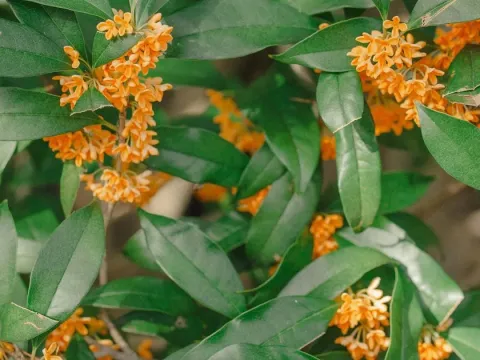
Osmanthus
Osmanthus
Osmanthus is a genus of evergreen shrubs and small trees belonging to the Oleaceae family. Native primarily to East Asia, these plants are highly regarded for their intense fragrance and ornamental value. They thrive in mild climates and are widely cultivated for both aesthetic and commercial purposes.
What the section contains
 American osmanthus
Osmanthus americanus
American osmanthus
Osmanthus americanus
 Armed Osmanthus
Osmanthus armatus
Armed Osmanthus
Osmanthus armatus
 Asian Osmanthus
Osmanthus asiaticus
Asian Osmanthus
Osmanthus asiaticus
 Burkwood osmanthus
Osmanthus burkwoodii
Burkwood osmanthus
Osmanthus burkwoodii
 Fortune's Osmanthus
Osmanthus fortunei
Fortune's Osmanthus
Osmanthus fortunei
 Orange Osmanthus
Osmanthus aurantiacus
Orange Osmanthus
Osmanthus aurantiacus
 Osmanthus decorus
Osmanthus decorus
Osmanthus decorus
 Osmanthus hybrid
s
Osmanthus hybrid
Osmanthus hybrids
 Osmanthus insularis
Serrulated osmanthus
Osmanthus serrulatus
Sweet olive
Osmanthus suavis
Osmanthus insularis
Osmanthus insularis
Serrulated osmanthus
Osmanthus serrulatus
Sweet olive
Osmanthus suavis
 Yunnan osmanthus
Osmanthus yunnanensis
Yunnan osmanthus
Osmanthus yunnanensis
Osmanthus
The plant requires fertile, well-draining soil with a slightly acidic to neutral pH. Proper soil structure is essential, as the roots are sensitive to waterlogging. Adding organic matter to the soil can improve both moisture retention and aeration, supporting healthy root development.
Osmanthus plants prefer sunny to partially shaded locations. While they can tolerate some shade, increased exposure to sunlight often leads to more abundant blooming. Protection from harsh, drying winds is crucial, especially for younger plants, to prevent leaf desiccation.
Agronomic practices include consistent fertilization throughout the growing season. A balanced, slow-release fertilizer is recommended in early spring, while late-season applications should focus on potassium to help the plant harden off before winter.
Pruning is an integral part of Osmanthus care. Regular shaping encourages a denser, bushier growth habit and helps in maintaining the desired form. It is best to prune immediately after the flowering season to avoid removing buds for the next cycle.
The primary economic output of Osmanthus is its fragrant flowers. These are harvested and processed for use in the food and beverage industry, most notably for scenting tea and creating natural floral extracts for perfumes and culinary applications.
Yield efficiency depends on the cultivar selection and the maturity of the plants. Commercial orchards focus on high-flowering varieties that provide a sustained harvest window during the peak blooming season.
Harvesting is performed manually to ensure the delicate flowers are not damaged. The timing is critical; flowers should be picked at the stage of full opening when their aromatic oils are most concentrated. Post-harvest, they are processed quickly to maintain oil quality.
Maximizing yield also involves managing the plant's environment, ensuring adequate irrigation and nutrient availability during the growth phases that precede flowering. Modern plantations use precision farming techniques to monitor plant health.
Beyond flowers, some parts of the plant are utilized in traditional medicine, although the primary market remains the scent and flavor industry, which values the distinct, sweet, peach-like aroma of the blossoms.
Osmanthus is generally robust but can be affected by fungal diseases, such as leaf spot, particularly in areas with poor airflow and excessive moisture. Improving ventilation and spacing between plants are effective preventive measures against such outbreaks.
Pests like scale insects and mealybugs are common threats. These insects feed on the sap, causing foliage yellowing and potentially leading to sooty mold growth. Early detection through regular monitoring is key to keeping populations under control.
Spider mites can become a problem in greenhouse environments or during hot, dry spells. Maintaining adequate humidity and using specialized acaricides are the standard methods to mitigate mite infestations and protect plant vitality.
Integrated Pest Management (IPM) strategies are highly recommended for Osmanthus growers. By combining biological controls, cultural practices, and judicious use of pesticides, farmers can maintain plant health while minimizing environmental impact.
Overall plant hygiene—including the prompt removal of fallen leaves and infected debris—is fundamental to preventing the spread of pathogens within an orchard or garden setting.