
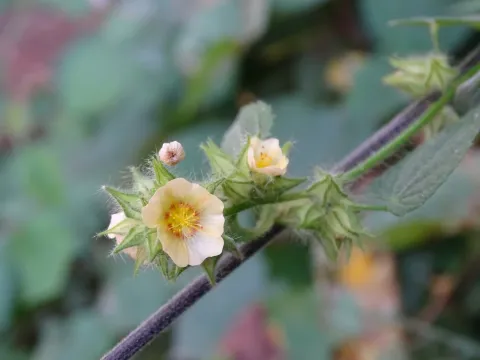
Sida urens
Sida urens
Sida urens is a warmth-loving crop, therefore planting should only be carried out once temperatures are stable and the soil at a depth of 5-10 cm has reached at least 15-18 degrees Celsius.
What the section contains
Sida urens
In tropical and subtropical regions, the sowing period is typically aligned with the onset of the rainy season to provide seeds with the moisture required for consistent germination.
For high-quality fiber production, seeds should be sown in rows with a spacing of 30 to 45 cm, which encourages plants to grow straight, unbranched stems suitable for harvesting.
The seeding rate must account for the germination percentage and desired plant density, as overly sparse planting leads to excessive branching, which decreases the quality and yield of the fiber.
Field preparation involves deep tilling and leveling the soil surface, as the small seeds of Sida urens require close contact with the seedbed to ensure uniform emergence across the field.
Sida urens is a member of the Malvaceae family, native to tropical areas of Central and South America, and is well-adapted to high levels of sunlight and heat.
The crop performs best in well-drained loamy soils with a neutral or slightly acidic pH, and it does not tolerate waterlogged conditions that can lead to root system decay.
While the plant is highly heat-tolerant, it requires steady and sufficient moisture during the active stem elongation stage to maximize vegetative growth and fiber development.
Optimal light exposure is critical; the plant should be grown in open, sunny locations, as shading can cause stems to lean and significantly reduce the mechanical strength of the fiber.
A distinctive botanical feature of this species is the presence of stinging hairs on the stems, which serve as a natural defense mechanism against various types of herbivorous insects.
The primary economic value of Sida urens lies in its bast fiber, which possesses mechanical properties suitable for use in the textile industry or for producing strong twine and cordage.
The yield of green biomass depends on high-quality management, including timely nitrogen fertilization during early vegetative stages and maintaining an optimal plant stand density.
When managed properly, the dry fiber yield per hectare can be substantial, making this plant an attractive candidate for localized textile and fiber processing industries.
Beyond fiber extraction, the plant can be utilized as a biomass source with high caloric value, making it suitable for energy production or as a substrate for paper pulp manufacturing.
Professional monitoring of stem height and diameter throughout the season allows agronomists to forecast fiber yield and determine the precise timing for harvest to ensure peak quality.
Major threats to Sida urens include fungal pathogens that attack the root system, usually triggered by poor soil aeration or excessive moisture accumulation during the growing season.
Insect pests, including cutworms and various leaf beetles, can cause significant damage to the foliage, which reduces photosynthetic capacity and slows down the plant's overall growth rate.
Weed management is typically handled through mechanical inter-row cultivation during the early stages, complemented by the selective use of herbicides if the weed pressure becomes intense.
Preventing viral infections involves controlling insect vectors like aphids, as these pests can rapidly spread diseases across a plantation if not managed with integrated pest control methods.
Crop rotation is a vital preventive strategy; it is recommended to avoid planting Sida urens in fields recently used for other Malvaceae crops to prevent the buildup of soil-borne pathogens.
Harvesting is best performed at the onset of peak flowering, as the stems at this stage contain the highest proportion of high-quality fiber with the ideal balance of flexibility and strength.
Mechanized harvesting involves mowing the stems, which are then processed through a retting stage to separate the bast fibers from the woody inner core of the plant.
Retting can be conducted in controlled water tanks or natural water bodies, where microbial activity breaks down the binding tissues, allowing for easy extraction of the fiber bundles.
Once extracted, the fibers are thoroughly washed, dried under the sun, and graded based on length and cleaning efficiency, which ultimately determines their market value.
The byproduct of fiber extraction, known as shive or hurd, can be repurposed as organic fertilizer or as an additive in the manufacturing of particle boards for the construction industry.