
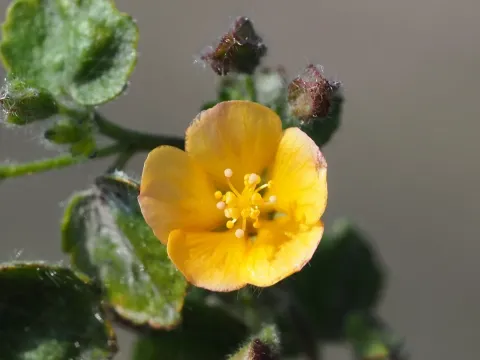
Sida cordata
Sida cordata
Sida cordata is a perennial herbaceous plant belonging to the Malvaceae family. It is characterized by a strong taproot system and erect or spreading stems covered with soft, fine hairs that are typical of many plants in this genus.
What the section contains
Sida cordata
In a field setting, propagation is primarily done through seeds. Sowing should occur once soil temperatures are consistently warm, as the plant is sensitive to frost and early-season cold spells during the germination phase.
Seeds should be planted at a shallow depth of 1–2 cm to ensure proper oxygen availability. Adequate soil moisture must be maintained during the first few weeks to support the establishment of a robust root system.
Row spacing of 45–60 cm is recommended to provide sufficient space for branching and lateral growth. This spacing also allows for easier mechanical weed control in the early growth stages.
Vegetative propagation via root division is also feasible for smaller research plots, ensuring genetic uniformity and reliable early-season growth for specific breeding goals.
Sida cordata thrives in full sun exposure and requires protection from high winds that could damage the stems. The ideal growth temperature range is between 20°C and 28°C for optimal fiber development.
The plant prefers well-drained, fertile loamy or sandy soils with a neutral pH (6.0–7.0). Poorly drained soils must be avoided as they significantly increase the risk of root pathogens.
While the plant shows moderate drought tolerance once established, consistent soil moisture throughout the growing season is essential for maximizing biomass production and fiber length.
Aeration of the soil is critical for healthy development. Frequent cultivation or hoeing between rows helps prevent soil crusting and promotes root oxygenation throughout the crop cycle.
Nutrient management should focus on balanced fertilization. Nitrogen application during the active vegetative stage encourages rapid stem elongation, which is vital for the fiber yield.
The primary agricultural value of Sida cordata lies in its bast fiber, which is known for its durability and resistance to wear, making it a viable alternative to other industrial fiber crops.
The biomass can be processed to produce ropes, cordage, and durable textiles. Its physical properties make it useful for reinforcement in composite materials and eco-friendly packaging.
Besides industrial use, the plant is studied for its medicinal properties, specifically the presence of various alkaloids that are extracted for use in pharmacological research and traditional medicine.
Under optimal agronomic conditions, biomass yields can reach 15–20 tons per hectare. Success in yield optimization relies heavily on plant density management and timely nutrient supply.
The crop's adaptability to various regions makes it an interesting candidate for diversifying agricultural portfolios, especially in tropical and subtropical climatic zones.
Root rot, caused by excessive moisture and poor drainage, is the most common threat to the longevity of the stand. Prevention through proper water management is the best defense.
Pests like aphids and spider mites can damage the foliage and inhibit plant growth. Integrated pest management (IPM) using beneficial insects or botanical extracts is recommended.
Weed competition is particularly severe during the first month. Effective weed management at this stage is essential to prevent the crop from being stunted by more aggressive herbaceous species.
Powdery mildew can occur in humid, stagnant conditions. Improving airflow through appropriate spacing and avoiding overhead irrigation can significantly reduce the incidence of fungal issues.
Crop rotation is essential for long-term productivity. Rotating with non-Malvaceae crops every 3–4 years helps break the life cycles of soil-borne diseases and pests associated with Sida species.
Harvesting is typically timed at the early flowering stage, when the fiber quality and stem cellulose content are at their peak for industrial processing purposes.
Mechanical harvesting via mowing is efficient, with the cutting height set at 5–10 cm to allow for potential secondary regrowth and biomass accumulation later in the growing season.
Immediately after harvest, the biomass must be dried in well-ventilated areas to prevent fermentation and mold growth, which can irreversibly degrade the quality of the fiber.
Processing involves decortication or water-retting to separate the valuable bast fiber from the woody core (hurd) of the stem, a process that requires careful moisture and temperature control.
The final fiber product should be stored in a dry, cool, and protected environment to maintain its mechanical properties and color for storage periods extending over several months.