
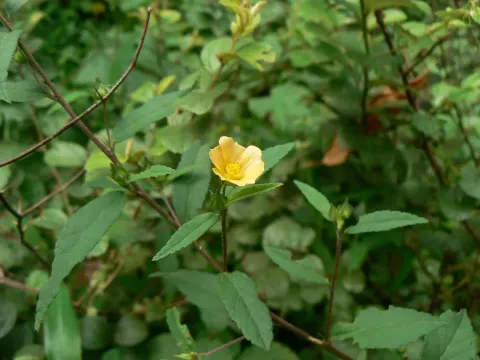
Sida acuminata
Sida acuminata
Sida acuminata is a perennial herbaceous plant belonging to the Malvaceae family. Originating from tropical and subtropical regions of the Americas, this species has gained interest among researchers and agronomists as a sustainable source of bast fiber, similar to other members of the mallow family.
What the section contains
Sida acuminata
The plant thrives in warm climates, requiring long growing seasons with plenty of sunlight. While it can withstand moderate dry spells due to its well-developed root system, optimal productivity is achieved in regions with reliable annual rainfall or under consistent irrigation schedules.
Soil requirements for Sida acuminata are generally low, although it performs best in loose, well-drained loamy soils. It is sensitive to waterlogging, so field selection must ensure proper drainage to prevent root rot and other physiological disorders that can stunt the plant's growth.
Agronomic management involves preparing a clean seedbed to minimize early competition with weeds. Once established, the plant exhibits vigorous growth, shading out surrounding weeds and requiring minimal chemical intervention, which makes it a suitable candidate for sustainable farming systems.
Botanically, the species is distinguished by its pointed, acuminate leaves and robust stems that grow straight, facilitating efficient harvesting. Nutrient management should focus on balanced NPK ratios, with specific attention to nitrogen to maximize the total biomass and fiber length during the vegetative phase.
The main commercial value of Sida acuminata lies in its stem fibers, which are extracted through industrial processing. These fibers are recognized for their mechanical strength and durability, making them highly desirable for the production of biodegradable ropes, twines, and reinforced biocomposite materials.