
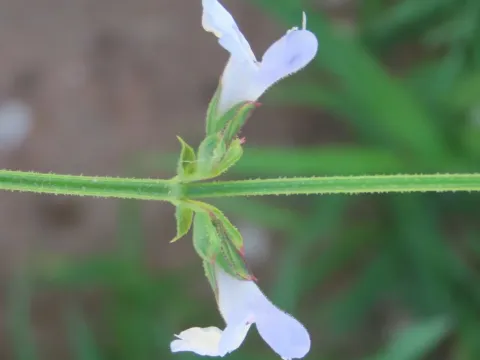
Narrow-leaf sage
Salvia stenophylla
Narrow-leaf sage (Salvia stenophylla) is a perennial herbaceous plant belonging to the Lamiaceae family. In agricultural practice, it is primarily propagated by seedlings to ensure uniform crop establishment and higher initial survival rates.
What the section contains
Narrow-leaf sage
Seed sowing for seedling production typically begins in late February or early March. This timing allows for sufficient root development before transplanting into the field in May, once the risk of spring frost has passed.
When sowing seeds into trays, they should be covered with a thin layer of soil (0.5–1 cm). Seeds have a relatively slow germination rate, which is why professionals often suggest cold stratification to break dormancy and improve uniformity.
Spacing recommendations depend on the intended harvest method and farm equipment. A standard planting density often involves spacing rows 40–50 cm apart, with individual plants placed 20–30 cm apart within the rows.
Direct field seeding is only feasible in regions with warm climates and long growing seasons. In such environments, the optimal time for direct sowing is mid-April, once the soil has reached a consistent temperature of 10-12 degrees Celsius.
This crop requires full sun exposure to thrive and maximize the synthesis of essential oils. Ensuring that the site receives unobstructed sunlight throughout the day is critical for high-quality production.
Soil quality is paramount; plants prefer light, well-draining soils with a neutral or slightly alkaline pH. Waterlogging is the most common cause of crop failure, as the root system is highly sensitive to excessive moisture.
While the plant exhibits excellent drought tolerance, supplemental irrigation is necessary during the first year of growth to help young plants establish deep, resilient root systems.
Fertilization should be handled with care, as excessive nitrogen promotes foliage growth at the expense of oil production. Potassium and phosphorus-based fertilizers are preferred to support overall plant vigor and winter hardiness.
In colder regions, mulching around the root zone is recommended during the winter months. This practice stabilizes soil temperature and protects the dormant crown from extreme fluctuations and desiccation.
Yield potential of narrow-leaf sage increases as the plantation matures. Peak biomass production is typically observed between the second and third years following the initial establishment.
Farmers can generally expect a yield of 2 to 5 tons of fresh green matter per hectare. The moisture content of the harvested material is significant, and drying reduces the mass by approximately 70-75% while concentrating the plant's active compounds.
Regular harvesting and pruning are vital for long-term productivity. Cutting back the plants after flowering stimulates vigorous new growth, which ensures the plant is well-prepared for the subsequent growing season.
The optimal harvest timing is at the start of mass flowering, which is when the concentration of secondary metabolites and essential oils in the foliage and flowering stems is at its peak.
A well-maintained plantation can be productive for 5 to 7 years. Beyond this timeframe, vigor typically declines, indicating that the field should be rotated to other crops to maintain soil health and efficiency.
Fungal diseases related to high humidity represent the primary threat to this crop. Powdery mildew and downy mildew can spread rapidly in dense stands where air circulation is restricted.
Root rot is a particularly devastating condition, often appearing suddenly in poorly drained soils. Adherence to strict crop rotation practices is essential to prevent the buildup of soil-borne pathogens from other Lamiaceae species.
Insect pests, most notably spider mites and aphids, can cause significant damage by feeding on plant sap. This feeding leads to leaf curling, stunted growth, and reduced photosynthetic efficiency.
Slugs and snails can also pose a risk to young seedlings during damp spells. Implementing integrated pest management strategies, such as physical barriers or biological controls, is more effective than relying on broad-spectrum chemicals.
Disease control should prioritize prophylactic measures, such as maintaining proper plant spacing and ensuring good drainage. Bio-fungicides are preferred to ensure the final product remains suitable for medicinal or food-grade use.
Harvesting should be conducted on dry, sunny days, preferably during the morning hours once dew has evaporated. Harvesting at this time helps preserve volatile essential oils that are easily lost in high heat.
The stems should be cut 10-15 cm above the soil surface using sharp blades. Clean cuts are essential to minimize physical stress to the plant and promote faster regrowth after the harvest event.
After collection, the material must be transported to the processing area immediately. Allowing the cut material to sit in piles leads to internal heating and fermentation, which destroys the aromatic profile of the sage.
Drying must occur in shaded, well-ventilated areas or in controlled drying chambers at temperatures not exceeding 40 degrees Celsius. Higher temperatures will cause the volatile components to evaporate, resulting in inferior quality.
Once fully dried, the crop should be cleaned to remove debris and stored in airtight containers. Properly processed narrow-leaf sage will retain its potency and aromatic characteristics for up to two years if stored in a cool, dark place.