
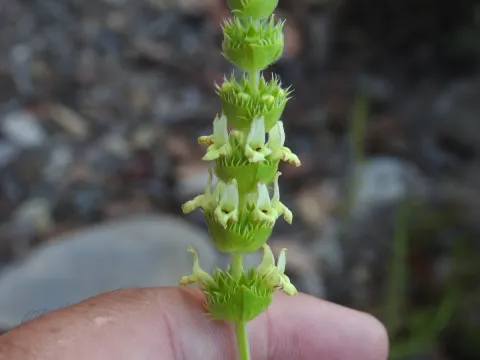
Mountain tea
Sideritis arborescens
Sideritis arborescens, commonly known as a type of mountain tea or ironwort, belongs to the Lamiaceae family. It is a perennial subshrub native to the rocky, arid regions of the Mediterranean basin.
What the section contains
Mountain tea
The plant thrives in well-drained, limestone-rich, and rocky soils. It is highly adapted to drought conditions and performs poorly in heavy, clay-based soils that retain moisture for too long.
Full sun exposure is a non-negotiable requirement for Sideritis arborescens. Insufficient light results in weak, leggy growth and significantly reduces the concentration of active essential oils in the foliage.
Temperature-wise, it prefers mild, Mediterranean-style climates. While it can handle occasional frosts, prolonged exposure to extreme damp cold can damage the root system and reduce plant vigor.
Agronomically, it is a low-input crop. Once established, it requires minimal irrigation and fertilizer, making it an excellent candidate for sustainable farming on marginal, rocky lands.
Sowing should take place in early spring once the risk of severe ground frost has passed. The soil temperature should be consistently above 12 degrees Celsius to facilitate germination.
Seed depth is critical; seeds should be sown very shallowly and only lightly covered with sand or fine compost. They require light to trigger the germination process successfully.
For commercial production, starting plants in trays within a greenhouse environment is common. This ensures higher survival rates during the initial vulnerable growth stage.
When transplanting into the field, spacing should be approximately 40 centimeters apart. This allows for proper airflow, which is the most effective natural defense against fungal pathogens.
During the first year, growth is typically focused on establishing a deep root system. Growers must remain patient, as vegetative biomass above ground remains limited until the second year.
The optimal harvest window is during the period of peak flowering. This is when the plant's essential oils, flavonoids, and antioxidants reach their highest concentrations.
The stems should be cut using clean shears, leaving about 10-15 centimeters of growth at the base. This ensures the plant can regenerate efficiently for the following season.
Drying must occur immediately after harvest in a shaded, well-ventilated area. Direct sunlight destroys delicate compounds and causes the leaves to lose their prized silver-green coloration.
Temperature control during drying is essential; the ambient temperature should not exceed 40 degrees Celsius to prevent the evaporation of volatile aromatic oils.
Once dried to a crisp texture, the product should be stored in airtight containers away from humidity to maintain quality for pharmaceutical or culinary distribution.
The most common threats to Sideritis arborescens include powdery mildew and various root rot diseases, both of which are primarily caused by excessive soil moisture and humidity.
Pests like aphids and spider mites can occasionally affect the plant, particularly in dry, high-heat conditions. These are usually managed through consistent monitoring and biological control agents.
Preventive agronomy is the primary line of defense. Ensuring excellent drainage, adequate space between rows, and weed control reduces the prevalence of fungal spores in the plantation.
Chemical intervention is strongly discouraged, as the plant is frequently consumed as a medicinal tea. Growers should prioritize organic, preventative methods to maintain crop health.
Regular field scouting is essential during the budding phase to identify potential infestations early, preventing widespread damage that could compromise the entire harvest's quality.
Yield stability for Sideritis arborescens increases after the first year as the plants become more robust. Commercial productivity typically peaks between years two and four of the plant's life cycle.
On average, growers can expect 1.5 to 3 metric tons of dried raw material per hectare, depending on soil quality, altitude, and the amount of seasonal sun exposure.
Higher yields are associated with intensive sun exposure and well-managed harvest cycles that allow for rapid regrowth of the plant's structural biomass.
Post-harvest care, including light fertilization after the season, can help extend the productive lifespan of the plantation and maintain high-quality leaf production.
Market demand for organic, high-quality mountain tea ensures that even moderate yields can be economically viable for small-to-medium scale specialized agricultural enterprises.