
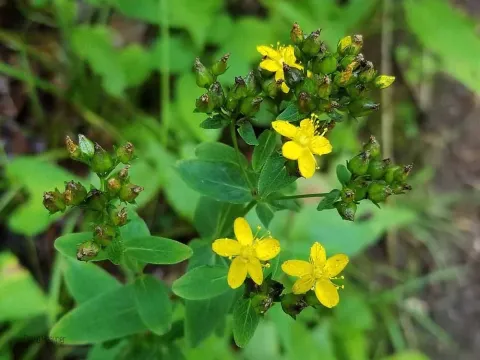
Hypericum corymbosum
Hypericum corymbosum
Sowing of Hypericum corymbosum is primarily performed in spring, during April or early May, when the soil temperature warms up to 10-12 degrees Celsius. The seeds are small, so they should be sown at a depth of no more than 0.5-1 cm.
What the section contains
Hypericum corymbosum
Late autumn sowing is also acceptable, providing natural seed stratification. This encourages more uniform germination in the spring and supports better root system development during the plant's first year.
When using row sowing methods, leave a distance of 45 to 60 cm between rows to facilitate inter-row maintenance. The seeding rate is approximately 2-3 kg per hectare, provided the seeds have high germination capacity.
After sowing, it is recommended to slightly roll the soil to ensure firm contact between the seeds and the substrate. In arid conditions, irrigation is critical to prevent the top layer of soil, where the seeds are concentrated, from drying out.
Seedlings emerge within 2-3 weeks after sowing, provided there is sufficient moisture. During the first year, the crop develops slowly, forming a rosette of leaves and building root mass, which requires thorough weed control.
Hypericum corymbosum belongs to the Hypericaceae family and prefers well-lit areas. The plant shows high ecological plasticity but is most productive on moderately moist, fertile loams or sandy loams.
The crop has moderate climate requirements and is well-adapted to winter frost in temperate zones. The optimal temperature for active vegetative growth ranges between 20-25 degrees Celsius.
Soil acidity is an important factor, with the plant favoring neutral to slightly acidic conditions. On highly acidic soils, preliminary liming is recommended to improve nutrient availability.
Cultivation practices include regular inter-row hoeing, which improves root aeration and moisture retention. The application of mineral fertilizers, especially nitrogen and phosphorus, significantly boosts the yield of raw plant material.
Stagnant water is detrimental to Hypericum, so select plots that avoid low-lying areas with high groundwater tables. In regions with hot summers, slight shading during midday is beneficial to protect leaves from overheating.
The economic use of Hypericum corymbosum is focused on obtaining pharmacopoeial raw material. The main products are the leafy tops of the stems, harvested during the plant's peak flowering stage.
The average yield of dried Hypericum herb ranges from 15 to 30 centners per hectare, depending on the plantation age and agronomic management. Maximum productivity is achieved in the second and third years after planting.
The raw material is widely used in the pharmaceutical industry to produce antidepressants and antiseptic agents. Essential oils and hypericin are the key biologically active components that determine the crop's value.
Beyond medicine, the plant is used in the food industry for flavoring beverages and producing dietary supplements. A high content of tannins makes it a valuable raw material for specialized cosmetic formulations.
Harvested material requires rapid drying at 40-50 degrees Celsius to preserve its natural color and high active substance content. Proper storage in dry, ventilated areas allows the product quality to be maintained for up to two years.
The crop is susceptible to fungal diseases, among which powdery mildew is the most dangerous. It appears as a white coating on leaves, reducing the quality and commercial appearance of the harvested herb.
Plantations are often affected by rust, which occurs in high humidity and due to improper crop rotation. Prevention consists of maintaining optimal plant density and timely weed removal.
Pests such as the St. John’s wort moth and various leaf beetles can cause significant damage by feeding on the foliage. Mass outbreaks of these pests can substantially reduce biomass accumulation.
For disease control, the use of biofungicides is recommended, as chemical agents limit the ability to use the harvest for medicinal purposes. Crop rotation remains an effective cultural method.
Timely monitoring of crop health allows for the localization of infection hotspots at early stages. If pest damage is severe, agronomic harvesting techniques are applied to remove affected parts before the insects spread.
Harvesting is performed during the mass flowering phase, when the concentration of biologically active substances in the plant is at its peak. At this time, the stem tops are cut at a height of about 10-15 cm above ground level.
It is important to avoid including coarse lower stem parts, as they decrease the quality of the final product. The use of specialized mowers allows for the mechanization of the harvesting process on large industrial scales.
The harvested material must be delivered to the drying site as quickly as possible to prevent self-heating and spoilage of the plant material. In hot weather, it is recommended to harvest in the morning hours after the dew has evaporated.
It is possible to conduct two cuts per season on Hypericum plantations if soil moisture levels are sufficient. A second cut is performed in late summer, leaving enough time for the plants to prepare for winter.
After harvesting, it is important to provide light fertilization to help the plant recover its vitality. This approach extends the plantation's productive lifespan to 5-6 years without the need for reseeding.