
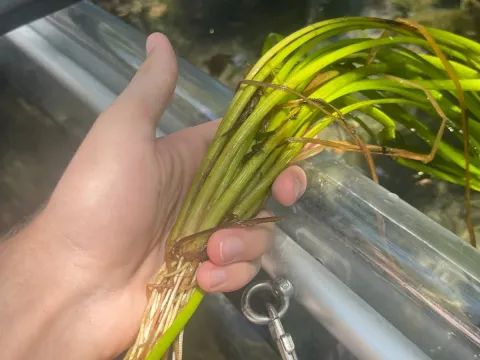
Vallisneria americana
Vallisneria americana
Vallisneria americana is a perennial submerged aquatic plant belonging to the Hydrocharitaceae family. It is native to North America, where it thrives in various freshwater habitats, ranging from slow-moving rivers to large, stable lakes.
What the section contains
Vallisneria americana
The plant is characterized by long, ribbon-like leaves that grow from a central rosette connected to a creeping rhizome system. This architecture allows it to stabilize substrates and provide essential structural complexity in aquatic environments.
Environmental requirements for the species include moderate to high light levels and a water temperature range of 20°C to 28°C. It prefers nutrient-rich substrates such as silt or sand mixed with organic matter to support its rapid vegetative growth.
Agricultural practices for managing Vallisneria focus on maintaining water clarity and providing a stable chemical environment. Propagation is primarily vegetative through runners, which makes the plant highly effective at colonization once established.
Beyond its ornamental appeal, the culture is valued for its role in water purification and oxygenation. It plays a critical role in sequestering nutrients and providing a habitat for diverse aquatic fauna, which underscores its utility in restorative ecology.
The most common biological threats to Vallisneria americana include competition with invasive algal species that thrive in eutrophic waters and shade the macrophytes.
Pathological issues often arise when water quality fluctuates, leading to the decay of root structures or the development of fungal infections on damaged leaves.
Herbivory by waterfowl or certain freshwater invertebrates can lead to significant biomass loss if populations of these animals remain uncontrolled in the growing area.
Environmental stress, such as turbidity caused by dredging or sedimentation, can physically smother the plants and halt their photosynthetic output.
Chemical pollutants and improper herbicide application designed for other aquatic weeds can lead to acute toxicity and the eventual decline of a healthy Vallisneria population.