
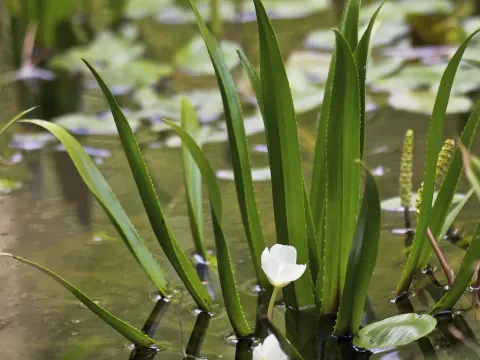
Water soldier
Stratiotes
The water soldier (Stratiotes aloides) is the sole member of its genus within the Hydrocharitaceae family. It is a perennial aquatic plant known for its peculiar habit of rising to the surface during summer and sinking to the substrate during the winter months.
What the section contains

Water soldier
Native to Europe and Western Asia, this plant thrives in standing or slow-moving water bodies. It prefers nutrient-rich environments where it can form dense, exclusive colonies that dominate the aquatic landscape.
The plant requires high light intensity to maintain vigorous growth. It is adaptable to various water qualities but thrives best in neutral to slightly alkaline pH levels, typical of freshwater lakes and drainage channels.
Botanically, it features stiff, sword-like leaves arranged in a tight rosette. The edges of these leaves are armed with sharp serrations, which serve as a physical defense mechanism against herbivores.
While not typically farmed in traditional agriculture, introducing it to artificial ponds requires careful management of water depth and light penetration. It reproduces mainly through vegetative propagation by offsets.
The primary agricultural and environmental use of the water soldier is in biofiltration. Due to its rapid growth rate, it effectively extracts nitrogen, phosphorus, and other contaminants from polluted waterways.
Composted biomass of the water soldier acts as a nutrient-rich organic fertilizer. It is particularly valued for its high potassium content, making it a viable additive for improving soil structure in small-scale farming.
Some historical records suggest its use as fodder after mechanical processing. However, due to the sharp leaf edges and toughness, it is rarely used as feed without preliminary treatment or ensiling.
In optimal nutrient-rich conditions, productivity can reach 15 tonnes per hectare of surface area. Harvesting is usually performed using specialized aquatic mowers during the late vegetative stage.
The plant's utility is primarily focused on environmental services, such as improving water quality and stabilizing sediment, rather than direct human food production or high-yield industrial farming.
Water soldiers are relatively hardy but are susceptible to fungal pathogens when water circulation is poor. Excessive crowding in stagnant ponds often leads to root and leaf rot, which can degrade water quality.
Pollution from heavy metals or industrial runoff can accumulate in the plant's tissues, eventually killing the rosettes. This makes it an indicator species for water purity in specific habitats.
Competitors like common reeds or invasive floating weeds can outcompete water soldiers for light, leading to a decline in population density. Proper pond management is essential to prevent such imbalances.
While few specific pests target the plant, generalist aquatic insects can feed on decaying organic matter, potentially spreading plant diseases within dense colonies.
Management of the water soldier is critical, as it can occasionally become invasive, clogging waterways and preventing light from reaching submerged oxygenating plants, which disrupts the aquatic food web.