
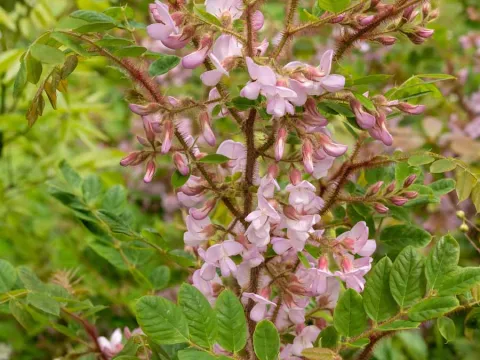
Robinia leucantha
Robinia leucantha
Robinia leucantha belongs to the Fabaceae family and is a resilient, nitrogen-fixing tree species often used in agroforestry and reforestation projects.
What the section contains
Robinia leucantha
The propagation of this culture is typically achieved through seeds. Due to their hard seed coat, pre-sowing treatments such as scarification or hot water soaking are essential to achieve uniform germination.
Sowing should take place in the spring after the danger of severe frost has passed. Seeds are drilled into prepared soil at a shallow depth, ensuring good contact with the substrate.
For establishing plantations, seedlings are typically transplanted in their first or second year. Early spring is the optimal time for planting to allow roots to establish before the onset of summer heat.
Planting density varies based on the intended use; denser spacing is preferred for windbreaks, while wider spacing is utilized for timber production or orchard-like apiary setups.
This species is highly photophilous and requires full sun exposure to thrive. Shade significantly inhibits growth and reduces the overall vigor of the tree.
It adapts well to a wide range of soil types, including sandy, gravelly, and nutrient-poor soils. Its ability to fix atmospheric nitrogen makes it an excellent pioneer species for soil restoration.
The tree exhibits remarkable drought resistance, making it suitable for regions with limited rainfall where other woody species might struggle to survive.
While mature trees are quite hardy, young plants require protection during their first few winters to avoid damage from frost and cold winds.
Proper drainage is essential, as the species does not tolerate waterlogged soils, which can lead to root system degradation and susceptibility to pathogens.
Robinia leucantha is highly valued in apiculture for its nectar production. It is a premier melliferous tree, capable of providing significant yields of high-quality, clear honey.
The timber produced by this tree is renowned for its strength, hardness, and natural resistance to decay, making it a valuable resource for long-lasting outdoor construction.
In short-rotation forestry, the species demonstrates a high biomass accumulation rate, providing a sustainable source of firewood and wood chips for energy production.
By fixing atmospheric nitrogen, the tree contributes to improved soil fertility, which indirectly benefits neighboring crops and supports biodiversity within the ecosystem.
The foliage, when processed, can serve as a supplementary nutritional source in animal husbandry, contributing to a more diverse and balanced diet for livestock.
The primary phytosanitary risks involve fungal infections, which can result in stem rots and branch dieback, particularly if the tree is already stressed by environmental factors.
Pests such as wood-boring beetles can cause structural damage to the trunk, weakening the tree and making it more prone to breakage during high winds.
Defoliating insects can significantly impact photosynthesis rates, especially in younger plantations, leading to stunted development if left unmanaged.
Sanitary management is crucial; removing dead or diseased branches helps to prevent the spread of infections and maintains the overall health of the tree population.
Integrated pest management, including regular monitoring and the use of targeted biological controls, is recommended to maintain the productivity of these stands.