
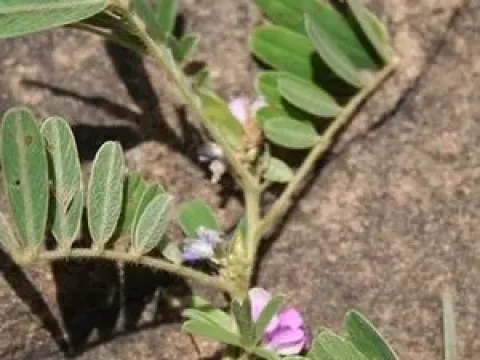
Tephrosia nana
Tephrosia nana
Tephrosia nana is a perennial herbaceous plant belonging to the Fabaceae family, recognized for its role in soil restoration and nitrogen fixation. Its compact growth habit makes it an ideal candidate for integrated cropping systems and ground cover management.
What the section contains
Tephrosia nana
The sowing schedule is primarily determined by the onset of the rainy season. Given its tropical origins, successful germination depends on adequate soil moisture, making it essential to time planting with the beginning of consistent rainfall to ensure rapid establishment.
Before planting, seeds often undergo mechanical scarification to overcome physical dormancy caused by hard seed coats. This pretreatment is vital for achieving uniform field emergence and higher germination rates, which are critical for establishing an effective stand.
Seeding density varies significantly depending on the specific objective, such as soil stabilization or biomass production. Higher densities are preferred for ground cover applications to maximize soil surface protection and weed suppression capabilities early in the season.
The optimal planting depth is between 2 and 4 centimeters. Ensuring good seed-to-soil contact through light harrowing or rolling is recommended, especially in sandy or loose soil types, to promote rapid moisture absorption and root development.
This crop is generally undemanding regarding soil fertility, exhibiting remarkable plasticity across diverse soil types. However, it performs best in well-drained, neutral to slightly acidic soils where nutrient leaching is minimized.
As a nitrogen-fixing legume, it establishes a symbiotic relationship with rhizobia bacteria, which facilitates its growth in nutrient-poor environments. This biological process not only supports the plant's own needs but also enriches the soil with organic nitrogen for subsequent crops.
Temperature requirements are high, as the plant thrives in warm tropical and subtropical environments. It is highly sensitive to frost, which limits its commercial cultivation to frost-free zones throughout the entire duration of its growth cycle.
Exposure to full sunlight is ideal for Tephrosia nana. While it possesses some tolerance to moderate shading, excessive canopy cover from taller trees or crops will result in reduced biomass accumulation and impaired vigor, affecting its overall soil-enriching potential.
Water requirements are moderate during the established phase, but consistent water availability during the early vegetative stage is crucial. Its deep taproot system eventually allows the plant to access subsoil moisture, ensuring survival during short dry spells.
Leaf-eating insects, such as beetles, pose the most significant risk to young stands. If left uncontrolled, these pests can drastically reduce the leaf surface area, thereby stunting early development and lowering the plant's overall productivity and vigor.
Fungal pathogens represent a primary health concern, particularly in environments with poor air circulation or prolonged waterlogging. Leaf spots and root rots can spread quickly under high humidity, necessitating proper field management and adequate drainage systems.
Root-knot nematodes are common in many legume-growing areas and can be particularly damaging to Tephrosia species. Incorporating crop rotation cycles that include non-host crops is essential for managing nematode populations and maintaining soil health.
Seed-feeding insects, specifically bruchid beetles, can threaten seed viability during the harvesting and storage processes. Protecting seeds from these pests is vital for ensuring the quality of the planting material for the subsequent growing season.
An integrated approach to pest management, including regular crop monitoring and selecting resistant varieties where possible, is key to maintaining the long-term viability of the stand in agricultural landscapes.