
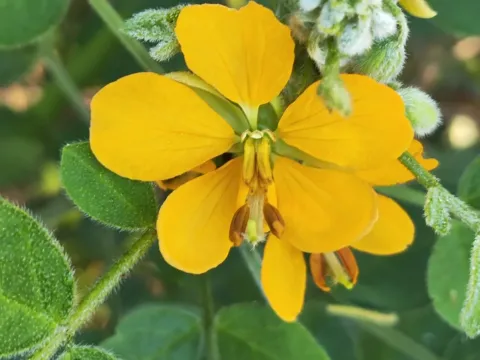
Hairy senna
Senna hirsuta
Hairy senna is a tropical plant that requires warm temperatures for optimal germination and early development. Seeding should occur only when soil temperatures consistently remain above 20 degrees Celsius.
What the section contains
Hairy senna
In equatorial regions, planting is often synchronized with the start of the rainy season to ensure that seeds have sufficient soil moisture for establishment.
Seed treatment, specifically scarification, is highly recommended because the hard seed coat can significantly delay uniform germination if left untreated.
The optimal seeding depth ranges from 2 to 3 centimeters, ensuring the seed is sufficiently covered while allowing for energy-efficient emergence.
Spacing between rows should typically be between 45 and 60 centimeters, allowing for machine access and preventing overcrowding of the canopy.
As a member of the Fabaceae (Legume) family, Hairy senna thrives in full sunlight. It is sensitive to cold temperatures and frost, making it strictly a tropical or subtropical crop.
The ideal soil conditions include well-drained loamy or sandy substrates. It performs poorly in compacted or waterlogged soils, which can induce root decay.
Like many legumes, it exhibits nitrogen-fixing capabilities, which allows it to thrive in soils where nitrogen levels might be insufficient for other non-leguminous crops.
It prefers a neutral to slightly acidic soil pH. Adjusting soil acidity is rarely necessary unless the site has been degraded or is highly alkaline.
While mature plants demonstrate some drought tolerance due to their deep root systems, they require consistent moisture during the seedling and flowering stages to reach maximum potential.
Pest management for Hairy senna focuses on controlling leaf-eating insects, such as caterpillars and various beetle species, which can defoliate the plant during the vegetative phase.
Fungal pathogens, particularly those causing powdery mildew, are prevalent in environments with high humidity and poor airflow between plants.
Cultural control methods, including proper spacing and weed removal, are the first line of defense to prevent the rapid spread of infections across the field.
Crop rotation is essential to prevent the buildup of soil-borne pathogens that target legumes specifically, ensuring sustainable yield over several seasons.
Regular field scouting is recommended to detect initial signs of stress or infestation, allowing for localized treatments rather than wide-scale chemical applications.