
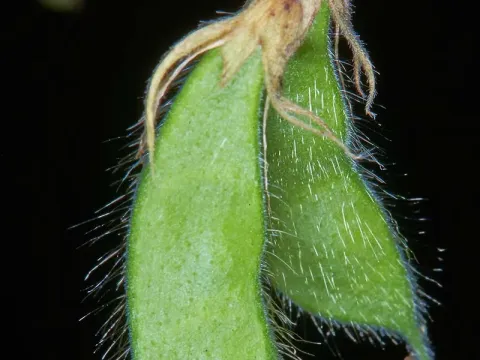
Hairy cowpea
Vigna comosa
Vigna comosa is a warm-season crop that requires soil temperatures above 15-18 degrees Celsius for germination. Planting should be timed to avoid any risk of late spring frost, typically occurring in late May or early June.
What the section contains
Hairy cowpea
Seeds are usually sown in rows with a spacing of 45-60 cm to allow proper root development and sunlight penetration. A planting depth of 3-5 cm is recommended, depending on the soil moisture content and texture.
Adequate moisture is essential for quick germination; therefore, pre-soaking seeds or ensuring sufficient irrigation during the sowing period can significantly increase seedling vigor. In dry conditions, deep sowing is not recommended.
The seeding rate varies based on whether the crop is grown for forage or grain. A lower density is preferred for grain production to minimize competition and ensure proper pod development, while higher density is used for biomass.
Direct seeding into the field is the most common method, as it promotes a robust taproot system. Although transplanting is technically possible, the shock often outweighs the benefits of an early start, making direct sowing more viable.
This legume thrives in well-drained, fertile loamy or sandy soils. It is sensitive to waterlogging and does not perform well in heavy, compacted clay soils, which can lead to poor aeration and root suffocation.
Vigna comosa is highly photophilic and requires full sun exposure to maximize photosynthetic activity and biomass production. Shaded environments tend to result in leggy, weak plants with significantly reduced flowering.
Optimal growth temperatures range from 25 to 30 degrees Celsius. While it has moderate drought tolerance, consistent moisture during the critical flowering and pod-filling stages is vital for achieving high yields.
As a legume, it performs best when inoculated with the appropriate rhizobia, allowing for effective nitrogen fixation. Phosphorus and potassium are the primary nutrients required to support pod development and root strength.
Implementing a proper crop rotation schedule is necessary to manage soil health and prevent the buildup of soil-borne diseases. Planting it after cereals is generally considered an excellent practice for field management.
The forage yield of Vigna comosa can range from 20 to 30 metric tons per hectare depending on soil fertility and climate. Proper management and adequate water supply are the primary drivers of biomass accumulation.
Grain yield typically fluctuates between 1 and 2 metric tons per hectare. This variation is largely influenced by the variety's adaptation to local light conditions and the efficiency of pollinator populations during flowering.
Implementing supplemental irrigation during the reproductive phase can improve grain yields by up to 20 percent. This is particularly effective in arid regions where rainfall distribution is often inconsistent.
Pollination is a key factor in yield stability; therefore, maintaining healthy bee populations in the surrounding area can enhance the fruit set. High pollinator activity correlates directly with higher pod density.
Continuous monitoring of plant development through the growing season allows for early identification of potential yield bottlenecks. Adjusting nutrient management based on visual plant health indicators is highly recommended.
Common diseases affecting Vigna comosa include powdery mildew and anthracnose, which are particularly prevalent in high-humidity conditions. Improving air circulation within the canopy is a primary preventative strategy.
Root rots pose a significant risk, especially in wet or poorly drained soils. Using high-quality, treated seeds and avoiding over-irrigation in the early seedling stages helps mitigate these fungal issues.
Insect pests, such as aphids and various bean weevils, can cause substantial damage to both leaves and pods. Regular scouting and timely application of targeted insecticides or biopesticides are essential for protection.
Spider mites may become a problem during hot, dry weather. These pests feed on the underside of leaves, causing yellowing and premature senescence, which reduces the plant's overall energy production capacity.
Integrated pest management (IPM) practices, such as removing crop residues and using biological control agents, help maintain a healthy field balance. Avoiding excessive nitrogen application can also help manage aphid populations.
Forage harvest is optimally timed during the peak flowering stage to ensure the highest nutritional value. Harvesting at this stage provides the best balance of protein content and biomass volume for livestock feed.
When harvesting for grain, it is essential to monitor pod maturation. The pods should be harvested when they are fully developed and show signs of color change, but before they become overly dry and prone to shattering.
Mechanical harvesting using combines is efficient for large-scale operations. For better results, desiccation may be used to achieve uniform plant senescence, ensuring a cleaner and more efficient threshing process.
Small-scale producers may prefer hand-harvesting, which allows for selective collection of the most mature pods. Harvested material must be dried quickly in a sheltered area to prevent fungal growth on the seeds.
Final seed processing includes winnowing and drying to achieve a stable moisture content of 12-14 percent. Proper storage in cool, dry conditions is necessary to maintain long-term seed viability and germination rates.