
Rigid medick
Medicago rigidula
Medicago rigidula, commonly known as rigid medick, is an annual legume species belonging to the Fabaceae family. It is valued for its hardiness and ability to thrive in challenging environments.
What the section contains
Rigid medick
The native range of this species extends across the Mediterranean basin, Southern Europe, and parts of the Middle East. It is well-adapted to regions with Mediterranean climates.
It prefers well-drained, alkaline to neutral soil types. It is notably drought-tolerant, making it a suitable candidate for pastures in semi-arid and arid climatic zones.
Botanically, it features a deep taproot system, which helps it access subsoil moisture during long periods without rain, ensuring survival and sustained biomass production.
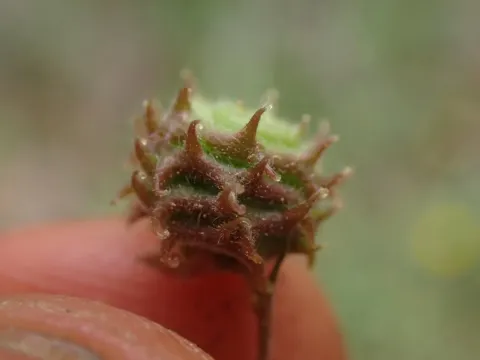
The plant exhibits a characteristic spirally coiled pod, which often features small spines. This morphology aids in the dispersal of seeds by attaching to animal fur, which is a classic example of epizoochory.
Sowing typically takes place in the autumn in mild winter regions or early spring in cooler climates. Precise timing is essential to ensure moisture availability during germination.
The seedbed must be finely prepared and free from competing weeds. Given the plant's slow early growth, weed control during the seedling stage is critical for successful establishment.
The recommended seeding rate varies based on the intended use, typically ranging from 15 to 20 kilograms per hectare. Uniform seed distribution is key to achieving a dense stand.
Seeds should be planted at a shallow depth of 1–2 centimeters. Rolling the soil after sowing improves soil-to-seed contact and encourages consistent germination across the field.
Selecting a clean, well-drained site is paramount. Avoid fields with high water tables or prone to waterlogging, as the species is highly sensitive to excessive root moisture.
Rigid medick provides high-quality forage rich in protein and minerals. It is particularly valued in sheep and goat husbandry for its nutritional density in arid settings.
Its productivity is highly dependent on rainfall patterns. In favourable years, it produces significant biomass that can be harvested as hay or grazed directly by livestock.
Proper grazing management is vital. Rotational grazing ensures that the plant has enough time to recover its photosynthetic capacity after being consumed by animals.
The forage quality remains high even as the plant matures. However, the peak nutritional value is reached just before or during the onset of the flowering stage.
When used as part of a pasture mixture, it contributes significantly to soil health by fixing atmospheric nitrogen, thereby reducing the need for synthetic nitrogen fertilizers.
Common threats include fungal diseases such as powdery mildew, which can spread rapidly under conditions of high humidity or poor air circulation within the canopy.
Pests like aphids and various weevils can cause significant damage to leaves and reproductive parts, potentially impacting the seed yield if not managed correctly.
Weed infestation is the primary threat to new plantings. If weeds outgrow the young medick, they can effectively block sunlight and steal nutrients, leading to crop failure.
Integrated Pest Management (IPM) strategies are recommended. This includes crop rotation and the use of resistant seed varieties to naturally reduce the incidence of pests.
Regular field scouting is essential to identify infestations early. Preventive measures such as adequate spacing and balanced soil fertility can also help maintain plant vigor.
Harvesting for forage should begin at the early flowering stage to maximize protein content. At this stage, the ratio of leaf to stem is at its most optimal for digestibility.
Haymaking requires careful handling. Because the leaves are delicate and prone to shattering, it is recommended to use equipment that minimizes mechanical stress during curing.
Seed harvesting requires precision. Since the pods are coiled and can be fragile, harvesters must be adjusted to prevent seed damage while ensuring all pods are captured.
Post-harvest, seeds must be dried and cleaned promptly. Storing seeds with excessive moisture content will significantly reduce their viability and lead to fungal development.
Efficient storage facilities with good ventilation are necessary to keep the harvested seeds or hay in good condition until they are ready for use or market distribution.