
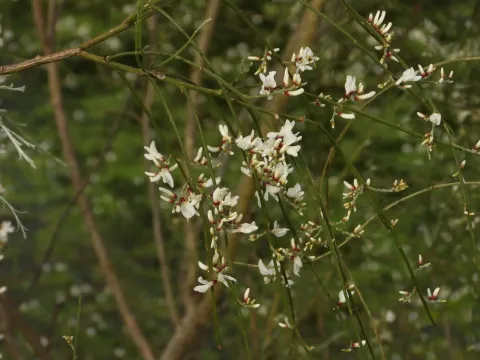
Retama
Retama
Retama is well-adapted to arid regions, typically germinating at the end of the rainy season when soil moisture levels are sufficient for initial development.
What the section contains

Retama
Under controlled agricultural conditions, seeds require mechanical or chemical scarification to break their hard coat, significantly increasing germination rates.
Sowing in nurseries is ideally performed in early spring, allowing seedlings to establish a strong root system before the intense summer heat arrives.
Seeds should be sown at a depth of 1-2 centimeters, maintaining a consistent soil temperature of approximately 20–25 degrees Celsius for optimal results.
Rapid taproot development is a signature trait of the species, enabling it to penetrate deep soil layers early in its growth cycle.
Belonging to the Fabaceae family, Retama is highly renowned for its exceptional tolerance to extreme drought, salinity, and nutrient-poor substrates.
The plant thrives in well-drained sandy or rocky soils, as poor aeration and stagnant water represent significant risks to its root health.
As a light-loving species, it requires maximum sun exposure throughout the growing season to maintain its metabolic functions and growth rate.
It possesses the capability to fix atmospheric nitrogen through symbiotic relationships with specific bacteria, allowing it to colonize impoverished lands.
The natural habitat includes Mediterranean and desert climates, where it demonstrates remarkable resistance to large diurnal temperature variations.
In agricultural practice, Retama is primarily utilized for soil stabilization and sand dune fixation rather than for traditional crop harvest.
Its biomass serves as a valuable source of organic matter, which gradually improves the structure and fertility of degraded desert soils.
The extensive root architecture acts as a mechanical barrier against wind erosion, making the species essential for desertification control programs.
Retama plantations create a localized microclimate that supports the recovery of biodiversity in fragile arid ecosystems.
Locally, the shrub is also valued for its resilient woody branches, which are used as a traditional source of fuel and artisanal materials.
Fungal diseases affecting the root zone are the most common threat, typically triggered by improper irrigation or inadequate soil drainage.
Several specialized insects, including leaf-eating beetles, may cause seasonal damage to the plant's succulent, green branches.
Nutrient deficiencies, particularly on highly eroded soils, can lead to chlorosis and reduced vigor, making the plant susceptible to environmental stress.
Overgrazing by livestock remains a significant challenge, as the consumption of tender shoots inhibits the plant's ability to propagate and regenerate.
Integrated pest management should focus on maintaining optimal drainage and preventing overstocking in areas where the shrub is planted.
Harvesting for biomass or environmental purposes is conducted through selective pruning, which encourages denser branching and overall shrub health.
The frequency of pruning cycles is determined by the growth rate of the population and the specific management goals for the area.
Seed collection is performed manually after the pods have reached full maturity, marked by a distinct change in texture and color.
Post-harvest storage must occur in a dry, ventilated environment to protect the seeds from fungal decay and maintain high viability for future seasons.
Sustainable harvesting techniques ensure the longevity of the plant, allowing it to continue its vital role in land restoration and stabilization.