
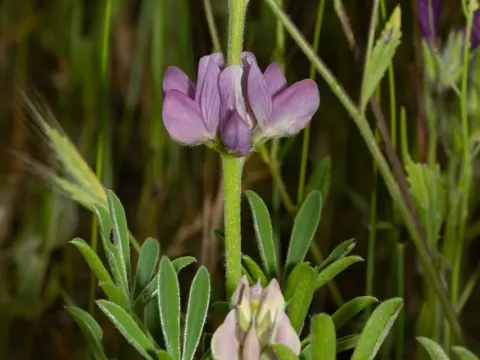
Spanish lupin
Lupinus hispanicus
Sowing of the Spanish lupin (Lupinus hispanicus) is carried out in early spring, as soon as the soil warms up to 5–8 degrees Celsius. This crop is noted for its good cold resistance, which allows it to successfully develop in temperate climate conditions.
What the section contains
Spanish lupin
The optimal planting depth is between 3 and 5 centimeters, depending on the soil texture. It is crucial to ensure good contact between the seed and soil moisture to achieve uniform emergence.
Seeding rates are calculated based on the intended use: denser stands, up to 1.5–2 million viable seeds per hectare, are used for green manure or forage. For seed production, the density is reduced to promote better branching.
Pre-sowing treatment of seeds with rhizobial inoculants is mandatory, as it significantly enhances the plant's nitrogen-fixing capability. This ensures robust growth without the need for excessive mineral fertilization.
The best sowing method is row drilling with 15–30 centimeter spacing between rows. This facilitates subsequent maintenance and weed control during the early stages of plant development.
Spanish lupin prefers light, well-drained sandy or sandy-loam soils. It shows high tolerance to slightly acidic environments, making it an excellent crop for rotation with various agricultural plants.
The plant is light-loving and develops most actively in open, well-lit fields. Shading during the initial growth stages can lead to stem elongation and a reduction in potential productivity.
The crop is highly drought-tolerant due to a deep taproot system that reaches into the lower soil horizons. This allows the plant to maintain viability even during periods of severe lack of rainfall.
Moderate temperatures during the flowering and pod formation stages are necessary for normal development. Excessively high temperatures during this time can negatively affect seed setting.
The soil must be well-aerated, as waterlogging and compaction lead to root rot. This plant is extremely sensitive to excess carbonates, which is why it performs poorly in highly alkaline soils.
The green mass yield of Spanish lupin can reach 25–40 tons per hectare, depending on management practices and seasonal weather. The quality of the biomass makes it a valuable high-protein feed resource.
Seed yield under optimal conditions ranges from 1.5 to 2.5 tons per hectare. Maintaining a high-quality seed bank is essential for ensuring stable harvests in future years.
Biological nitrogen fixation provided by lupin allows the soil to accumulate up to 150–200 kilograms of organic nitrogen. This is equivalent to applying significant amounts of mineral fertilizers for subsequent rotation crops.
Maximum protein yield per unit area is achieved when green mass is harvested at the peak flowering stage. At this point, the plant contains the most balanced profile of amino acids and vitamins.
Productivity is heavily dependent on the availability of micronutrients in the soil, particularly molybdenum, which is required for the activity of nitrogen-fixing bacteria. Proper micronutrient management significantly boosts yield results.
Major phytopathological threats include Fusarium wilt, which affects the plant's vascular system. The disease progresses under high humidity and poor crop rotation practices.
Anthracnose poses a serious danger, manifesting as dark spots on stems and pods. Disease control involves seed dressing and maintaining proper spatial isolation between fields.
Among pests, lupin aphids and nodule weevils cause the most damage. They attack both vegetative organs and the root system, weakening the plant and making it vulnerable to other stressors.
Nematodes can cause gall formation on roots, preventing proper nutrition and development of the lupin plant. Regular field rotation and the use of healthy seed material are the primary defense methods.
- Prophylaxis through crop rotation (a return interval of 4–5 years).
- Use of resistant bred varieties.
- Timely application of fungicides during critical growth phases.
Harvesting for green mass should take place during the mass flowering period when protein content is at its peak. At this stage, the biomass is tender and easily digestible for livestock.
For seed production, harvesting begins when most pods turn dark and seeds dry out. It is important not to delay the harvest, as ripe pods may shatter, leading to significant crop losses.
Direct combining is the preferred harvesting method if the fields are weed-free. If there is high weed infestation, swathing followed by threshing of the dried material is recommended.
Post-harvest seed processing includes mandatory cleaning and drying to a moisture content of 12–14 percent. This ensures seed viability and prevents fungal growth during storage.
The harvested crop should be stored in dry, well-ventilated facilities protected from pests. Proper storage conditions allow seeds to maintain germination capacity for several years.