
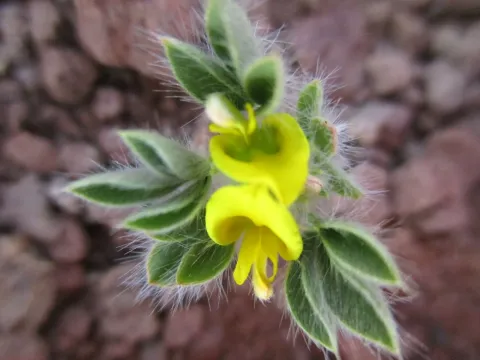
Lotononis platycarpa
Lotononis platycarpa
Lotononis platycarpa is a perennial legume belonging to the Fabaceae family, noted for its hardiness in challenging environmental conditions where other forage crops often fail.
What the section contains
Lotononis platycarpa
Seeds are known for high levels of hard-seededness, which necessitates mechanical or chemical scarification to break dormancy and ensure uniform emergence in the field.
The ideal sowing window aligns with the onset of the rainy season, allowing the root system to establish thoroughly before the onset of extreme heat or dry spells.
Due to the small seed size, a shallow planting depth is critical, ideally ranging between 10 to 15 millimeters to facilitate optimal germination without burying the seeds.
Successful establishment requires a firm seedbed and good soil-to-seed contact, as the young seedlings are initially slow to grow and require careful weed management.
This species thrives in sandy and light-textured soils that are typically considered poor for traditional row crops, making it a valuable addition to marginal land utilization.
It displays remarkable drought tolerance, which is an evolutionary trait derived from its origin in arid southern African environments, allowing it to survive prolonged water stress.
The primary environmental restriction is soil drainage; Lotononis platycarpa is highly sensitive to waterlogging, which quickly results in root rot and plant mortality.
It prefers full sun and open areas, showing poor performance when shaded by taller canopy cover or encroaching woody vegetation, which suppresses its natural spreading habit.
Nutrient requirements are modest; however, basic phosphorus supplementation often boosts biomass production and enhances the effectiveness of nitrogen-fixing nodules.
The primary use of Lotononis platycarpa is as a high-quality forage source for livestock, providing essential protein content in regions with otherwise sparse vegetation.
It is well-suited for grazing systems, as its growth habit allows for decent recovery after periodic consumption by small ruminants like sheep and goats.
Beyond its feed value, this plant serves as a vital component in restorative agriculture, as it fixes atmospheric nitrogen, thereby improving soil fertility for future crops.
The forage remains palatable and nutrient-dense even during the early stages of dry-down, which is a significant advantage for producers managing seasonal feed shortages.
Productivity is generally linked to seasonal rainfall patterns, yet the plant maintains structural integrity and provides consistent cover compared to more fragile grasses.
Root rot pathogens represent the most significant threat, particularly in soils that do not drain effectively, leading to decay during humid or high-precipitation events.
Insect pests such as leaf-eating beetles and various aphid species can cause localized damage, particularly during the early vegetative stages when the plants are most vulnerable.
Competition from aggressive, fast-growing weeds during the first month after germination is the most common reason for total failure in new agricultural plots.
Chemical control measures must be applied with extreme caution to avoid phytotoxicity, as the species may show high sensitivity to certain types of broadleaf herbicides.
Strategic management of grazing intensity is essential to prevent overgrazing, which depletes root reserves and weakens the population, allowing opportunistic invasive plants to thrive.