
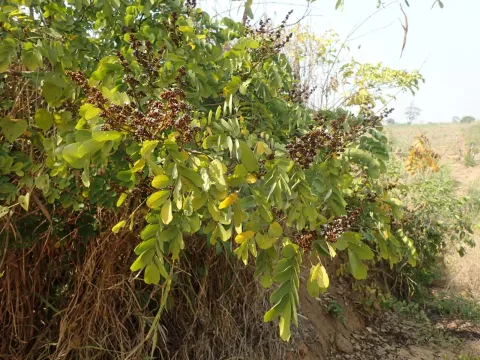
Dalbergia lactea
Dalbergia lactea
Dalbergia lactea is a robust woody vine species that belongs to the Fabaceae family. As a climbing shrub or liana, it possesses a significant capacity for growth, often reaching high into the forest canopy by utilizing its sturdy stems to wrap around and climb nearby host trees in its natural habitat.
What the section contains
Dalbergia lactea
The plant originates primarily from the tropical regions of East Africa and Madagascar. Its distribution is closely linked to woodland and forest edge environments, where it exploits the available solar radiation to support its dense foliage and prolific production of small, characteristic flowers.
Cultivation of this species requires a strictly tropical climate with consistent warmth throughout the year. It thrives in environments where temperatures remain between 22 and 30 degrees Celsius, and it is highly susceptible to frost damage, which necessitates sheltered growing locations in cooler latitudes.
Soil requirements for Dalbergia lactea include a well-drained, nutrient-rich substrate. While it can adapt to various soil types, loamy soils with high organic content facilitate optimal root development and overall plant vigor, provided that waterlogging is prevented to protect the root system.
Economically, the species is recognized for its versatility in ecological restoration and its potential use in local crafts. The flexible stems of the plant have historically been utilized for weaving and construction of small tools, and the plant serves as a vital component in supporting local biodiversity through nectar production.