
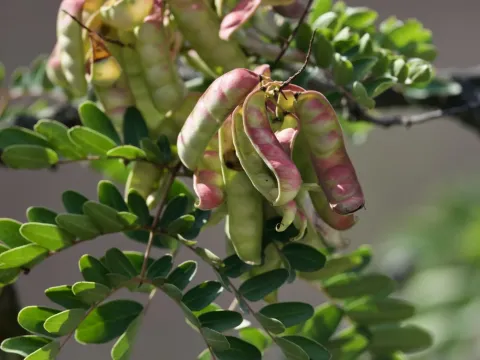
Tara
Caesalpinia spinosa
Tara is typically propagated by seeds, which require specific preparation to overcome their hard seed coat dormancy before planting in nursery beds.
What the section contains
Tara
Scarification or soaking the seeds in hot water is a necessary step to ensure uniform germination and to reduce the time required for the seedlings to emerge.
Seedlings are nurtured in nurseries until they reach a suitable height, generally between 30 and 50 centimeters, before being transplanted to their final field locations.
When establishing a plantation, precise spacing is critical to ensure that each tree has sufficient access to sunlight and soil nutrients as it matures.
The initial establishment phase requires consistent irrigation to help the root system penetrate the soil and adapt to the local environmental conditions.
Tara (Caesalpinia spinosa) is a leguminous plant native to the arid valleys and foothills of the Andes in South America, particularly in Peru.
This species is highly adapted to semi-arid climates, thriving in regions with high temperatures and low annual precipitation, demonstrating excellent drought resistance.
It prefers well-drained, porous soils and is often found growing in stony or sandy conditions, showing significant tolerance for low-fertility substrates.
As a nitrogen-fixing plant, it contributes to soil improvement, making it a valuable candidate for reforestation and sustainable agroforestry projects.
While tolerant of various soil types, the plant thrives best in areas with full sun exposure, which is essential for the optimal development of its pods.
The main commercial value of Tara lies in its pods, which are processed to extract Tara gum (a natural hydrocolloid) and high-quality tannins for industrial use.
Trees begin to produce fruit within a few years of planting, with yield increasing steadily as the tree reaches its peak maturity and full canopy size.
Productivity is influenced by the genetic quality of the seeds used and the environmental management practices implemented during the tree's growth cycle.
Regular pruning and maintenance are essential for maximizing the yield per hectare and ensuring that the tree remains productive over many decades.
With the growing global demand for natural food additives like E417, Tara plantations are increasingly recognized as a highly profitable agricultural enterprise.
Tara trees can be susceptible to various insect pests, particularly those that feed on foliage or target the maturing pods during the development stage.
Fungal diseases related to root rot can occur if the soil remains waterlogged or if the plantation lacks proper drainage during the wet seasons.
Integrated pest management strategies are encouraged to protect the crop while maintaining the environmental integrity of the agricultural site.
Maintaining proper tree spacing and thinning the canopy are effective preventative measures to improve air circulation and reduce disease incidence.
Regular monitoring of the plantation allows farmers to identify early signs of stress or infestation, enabling timely intervention to minimize losses.
Harvesting is performed when the pods reach full physiological maturity, indicated by their dry texture and deep brown or reddish-brown coloration.
Manual harvesting is the preferred method to ensure that only the highest quality pods are collected, preventing mechanical damage to the tree branches.
After collection, the pods are subjected to a drying process to ensure long-term stability and to prevent the development of mold or microbial degradation.
The dried pods are cleaned, sorted, and processed to separate the seeds from the pod material, as each part holds different industrial values.
Proper storage conditions are essential, requiring cool and dry environments to preserve the chemical properties of the gums and tannins until processing.