
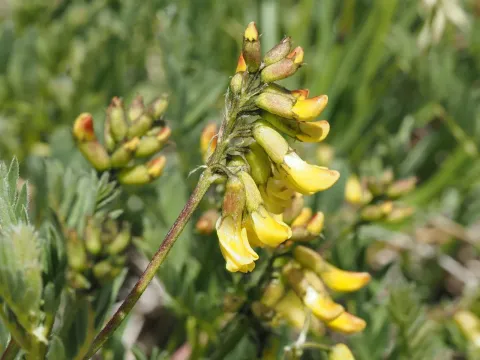
Pendulous-flowered milkvetch
Astragalus penduliflorus
Astragalus penduliflorus is best sown in early spring when the soil temperature reaches stable germination levels. Early establishment allows the plants to develop deep roots before the heat of summer.
What the section contains
Pendulous-flowered milkvetch
Seeds have a hard coat, so mechanical or chemical scarification is recommended to improve germination rates. This ensures a uniform stand establishment, which is critical for the success of the perennial crop.
Planting is typically performed using row seeders with row spacing between 15 and 30 centimeters. This provides sufficient space for individual plant development and minimizes competition within the row.
Seed placement depth should be shallow, generally between 1 to 2 centimeters. Ensuring proper soil-to-seed contact is essential for uniform emergence, especially in drier soil conditions.
During the establishment year, the crop focuses on root development and grows relatively slowly above ground. Weed management is crucial during this stage to prevent the crop from being choked by fast-growing weeds.
The plant is highly cold-hardy, making it suitable for temperate and cold climates. It shows excellent winter survival rates, maintaining its vigor even after harsh winter conditions.
Well-drained soil with a neutral to slightly alkaline pH is ideal for the cultivation of this species. It does not tolerate waterlogged conditions, which can lead to root system decay.
As a legume, it forms a symbiotic relationship with nitrogen-fixing bacteria. This reduces the need for external nitrogen fertilizers and enhances the overall nitrogen content of the soil.
Astragalus penduliflorus requires ample sunlight for optimal biomass production. It should be grown in open, sunny locations where it can perform photosynthesis efficiently throughout the growing season.
The crop displays significant drought resistance once established due to its extensive taproot system. This makes it a reliable forage option in regions where seasonal rainfall may be unpredictable.
Maximum productivity is typically achieved from the second year onwards. The crop is a robust perennial that provides reliable forage yields over several harvest cycles on the same field.
Nutrient management, particularly with phosphorus and potassium, can significantly boost forage quality and biomass yield. Maintaining soil fertility helps sustain the crop's productive lifespan.
Multiple cuttings per season are possible under favorable moisture conditions. It is important to leave enough stubble after each harvest to ensure rapid regrowth of the plants.
The species also serves as a good source of seed for pasture restoration projects. Monitoring the seed maturation process is essential to maximize the yield of high-quality, viable seeds.
The yield quality depends heavily on the timing of the harvest. Cutting at the correct vegetative stage ensures that the nutritional profile is preserved, providing high-energy feed for livestock.
Fungal diseases, including leaf spots, pose a risk during periods of high humidity. Proper field management, such as ensuring good air circulation, can help mitigate these risks effectively.
Common legume pests like aphids and weevils may occasionally infest the plants. Regular scouting is recommended, especially in spring, to detect potential outbreaks before they cause significant damage.
Root rots are the most common issue associated with poor drainage or over-irrigation. Proper site selection and land preparation are the most effective preventive measures against these pathogens.
Competition from weeds is a significant threat during the seedling stage. Implementing mechanical weeding or appropriate crop rotation cycles helps keep the infestation levels manageable.
Maintaining a rotation schedule is advised to prevent the buildup of soil-borne pathogens. Rotating away from legumes for a few years helps break the life cycle of specific pests and diseases.
Harvesting for forage should ideally occur at the onset of the flowering stage. This is when the concentration of proteins and essential nutrients in the foliage is at its highest level.
Quick drying after cutting is necessary to preserve the hay's quality, color, and aroma. Efficient hay-making processes prevent the loss of delicate leaves, which are the most nutrient-dense parts.
When harvesting for seed, the process should be timed to coincide with the browning of the pods. Early harvesting is necessary to prevent natural pod dehiscence and seed loss in the field.
Mechanical harvesting options include direct combining or two-stage harvesting. Two-stage harvesting allows for drying in windrows, which often results in higher seed quality and reduced shatter loss.
Post-harvest residues can be incorporated into the soil as green manure. This practice improves soil organic matter levels and supports the overall health and structure of the soil profile.