
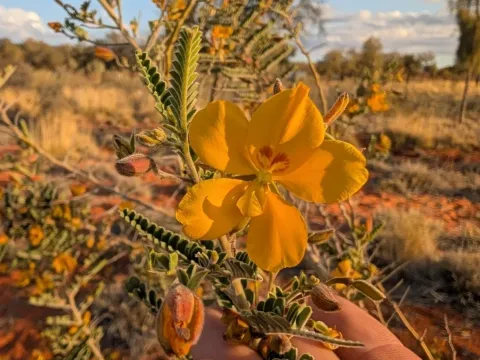
Petalostylis
Petalostylis
Petalostylis is a genus of shrubs and small trees belonging to the legume family, Fabaceae. These plants are primarily native to the arid and semi-arid regions of Australia, where they have evolved to withstand harsh conditions.
What the section contains

Petalostylis
The plant thrives in well-drained, sandy or gravelly soils that are characteristic of its natural habitat. It is highly intolerant of waterlogging, which can rapidly lead to root decay in cultivated environments.
Exposure to full sunlight is essential for the healthy growth and flowering of Petalostylis. It is considered a drought-tolerant species, capable of surviving long periods of water scarcity through deep rooting systems.
Botanically, it features pinnate leaves and distinctive yellow flowers, which serve as an important nectar source for local pollinators in the desert ecosystem. Like many legumes, it assists in soil nitrogen fixation.
While not a major commercial crop, it is studied for its potential in land rehabilitation and erosion control. Agricultural management focus is mainly on mimicking the natural environment to encourage stable growth.
The primary threats to Petalostylis include excessive land clearing and overgrazing by herbivores, which prevent the establishment of new seedlings.
Specific insect pests often target the reproductive organs of the plant, including seeds and pods, which can impact the long-term viability of small populations.
Fungal pathogens associated with damp environments can become a significant issue if the plant is grown in regions with high humidity levels.
Invasive non-native vegetation often poses a major competitive threat, displacing the plant by consuming scarce resources in its native range.
Environmental fluctuations, particularly unseasonably high rainfall, can disrupt the plant's natural adaptation to arid conditions, leading to physiological stress.