
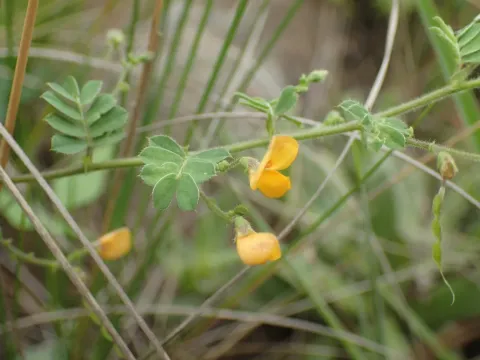
Aeschynomene brevifolia
Aeschynomene brevifolia
Aeschynomene brevifolia is a member of the Fabaceae family, prized in tropical agriculture for its rapid biomass accumulation. The optimal sowing time typically coincides with the beginning of the rainy season to ensure adequate soil moisture for germination.
What the section contains
Aeschynomene brevifolia
Seed preparation is crucial for success, often involving scarification to break dormancy and improve uniformity in sprouting. Sowing depth should be kept shallow, generally around 2 centimeters, to facilitate quick emergence.
Standard field planting involves row spacing that balances the need for plant density against the requirement for airflow. Proper population management helps the crop outcompete weeds during the critical early growth stage.
The crop thrives under full sun exposure and demands high light intensity for optimal photosynthetic activity. In regions with shorter days, supplemental care may be needed to ensure the plant reaches its full potential height and spread.
Success in sowing is heavily reliant on soil temperature stability, which must remain consistent to prevent the stunting of seedlings during their most sensitive developmental phase.
This legume species is highly adaptable to various soil types but demonstrates superior growth in well-drained, fertile loams. It requires an environment with good aeration to support the symbiotic nitrogen-fixing bacteria present in its root system.
Climatically, the crop is strictly tropical; it does not tolerate frost and requires consistent warmth throughout the growing season. A mean temperature range of 25 to 30 degrees Celsius is ideal for active growth and development.
While the plant displays notable tolerance for occasional flooding, it performs best in soils with a balanced water regime. Preventing long-term saturation is vital to avoid root rot and nutrient leaching that can occur in waterlogged conditions.
Agricultural management should prioritize maintaining optimal soil pH to maximize the efficiency of rhizobial nitrogen fixation. Periodic soil testing ensures that necessary phosphorus and potassium levels are maintained for high yields.
The plant's resilience is notable, but it does benefit from strategic irrigation during dry spells to prevent premature flowering and ensure continuous vegetative growth for better biomass yield.
Aeschynomene brevifolia is widely recognized for its high nutritional value, specifically its crude protein content, making it an excellent forage crop. Livestock readily consume the biomass, which significantly improves weight gain and health metrics.
Harvesting for fodder is most productive when the crop is managed through rotational grazing or repeated mechanical cuttings. This approach keeps the plants in a vegetative state, preventing the maturation that decreases digestibility.
As a green manure crop, it provides substantial benefits to the soil by increasing organic carbon levels and nitrogen availability for subsequent crop rotations. This practice supports sustainable soil management without heavy reliance on synthetic fertilizers.
The yield of seeds can be quite significant if the crop is allowed to mature properly during the dry phase. Seed production should be managed by limiting disturbances during the flowering phase to ensure successful pollination.
Overall economic returns are bolstered by the crop's low input requirements and its ability to regenerate quickly, providing multiple harvest opportunities within a single growing cycle.
Fungal infections of the foliage represent the most significant threat to production, especially in areas with high humidity. Ensuring proper spacing and airflow between rows is a primary cultural method to suppress the spread of fungal spores.
Insect pests, including various caterpillars and beetles, can cause localized damage to leaves and stems. Integrated pest management strategies, such as biological control and habitat maintenance for predatory insects, are preferred to minimize chemical use.
Nematode infestations can occur in exhausted or over-farmed soils, leading to reduced root efficiency and stunted overall growth. Crop rotation with non-host plants is the most effective long-term strategy for managing soil-borne threats.
Phytosanitary measures, such as cleaning harvesting equipment and using disease-free seeds, are essential to prevent the introduction of pathogens into new planting areas.
While the plant is robust, its health should be monitored closely during the rainy season when conditions are most favorable for disease development and rapid pest population growth.
Timing the harvest is critical for maximizing forage quality. Cutting should occur just as the plant begins to produce buds but before woody stems develop, which ensures the highest protein concentration and leaf-to-stem ratio.
When harvesting for seeds, the process begins when the pods start changing color and before they reach a stage of spontaneous dehiscence. Careful monitoring prevents significant seed loss due to shattering in the field.
Post-harvest handling requires quick drying of the biomass to lock in nutrients and prevent the growth of molds or mycotoxins. Proper moisture management during storage is non-negotiable for preserving the feed quality for long-term use.
Mechanical harvesting is highly efficient for large fields, requiring equipment calibrated for low-cutting heights to stimulate vigorous regrowth of lateral shoots from the crown.
Finally, storing the dried product in raised, ventilated areas keeps the fodder safe from ground moisture and pests, ensuring a reliable feed supply throughout the dry season.