
Rubber tree
Hevea Aubl.
Commercial propagation of the rubber tree is primarily achieved through budding, where high-yielding clones are grafted onto seedling rootstocks. Rubber seeds lose viability very quickly, so they must be sown in nurseries immediately after harvest.
What the section contains


Rubber tree
Seeds are prepared by soaking to accelerate germination, then placed in a moist substrate until the radicle emerges. This germination phase requires strict humidity control to prevent the embryos from rotting in the soil.
Transplanting young seedlings to the permanent plantation site usually occurs at the onset of the rainy season to ensure optimal establishment. Planting patterns are carefully planned, typically spacing trees to achieve a density of about 500 trees per hectare.
Early maintenance of young plantations involves regular weeding between rows to eliminate competition for water and nutrients. As the trees grow and form a canopy, the need for intensive soil maintenance decreases significantly.
The use of selected genetic clones allows plantations to reach the industrial exploitation stage sooner. Modern agrotechnology focuses on creating uniform stands to ensure consistent quality and yield of the harvested latex.
As a tropical species, the rubber tree has strict climatic requirements. The optimal mean daily temperature for vigorous growth ranges from 25°C to 30°C, and the plant is highly sensitive to frost, which can be fatal even in mature specimens.
The crop requires high and well-distributed rainfall throughout the year, with a minimum annual requirement of about 2000 mm. While the tree can tolerate short dry spells, sustained drought significantly impacts growth and latex flow.
Deep, well-drained alluvial or lateritic soils are ideal for rubber plantations. The plant is extremely susceptible to root rot if water stagnation occurs in the root zone, making proper soil drainage a non-negotiable requirement for site selection.
While mature trees thrive in full sunlight, seedlings can tolerate partial shade in the early stages. Proper spacing is essential to allow each tree enough room to develop a full canopy for optimal photosynthetic activity.
Maintaining soil fertility is critical for high yields, involving regular applications of nitrogen, phosphorus, and potassium fertilizers. Adequate nutrition ensures the tree has the energy to regenerate its bark after tapping cycles.
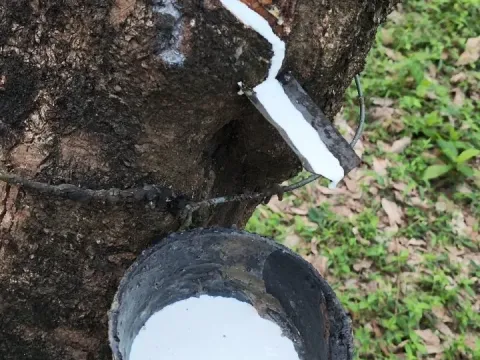
The main commercial product is latex, harvested by making controlled incisions in the tree's bark. Exploitation usually begins when the trunk reaches a target diameter, typically between 6 to 7 years after initial planting.
Yield capacity is determined by the specific clone, the age of the tree, and the precision of the tapper. With proper tapping techniques, a rubber tree can remain productive for 25 to 30 years before it is felled for timber.
The collected latex is processed into raw rubber through coagulation. This involves diluting the liquid with water and adding acids to form a solid rubber coagulum, which is then processed into sheets or blocks for shipping.
Annual yields of dry rubber vary depending on management practices and environmental conditions. High-performing plantations can produce between 1500 and 2500 kg of dry rubber per hectare annually.
Tapping frequency is strictly regulated, usually performed every other day to allow the tree to regenerate bark tissue. Over-tapping leads to physiological stress, reducing the tree's long-term health and total rubber output.
The most devastating threat to rubber trees is the South American Leaf Blight, caused by the fungus Microcyclus ulei. This disease has restricted the expansion of rubber cultivation in the Americas for decades.
Root rot diseases, often caused by Rigidoporus fungi, are common in poorly drained soils. These infections spread through the root system and often remain asymptomatic until the tree suddenly collapses or dies.
Pests like mealybugs and scale insects can attack young shoots, draining the plant of vital sap and stunting development. Regular monitoring and biological control programs are standard practice to keep pest populations at manageable levels.
Improper tapping wounds are dangerous as they serve as entry points for pathogens and wood-boring insects. These secondary infections can create unsightly galls and cause long-term damage to the tree's vascular system.
High winds during tropical storms pose a physical risk to plantations due to the relative brittleness of rubber wood. Large-scale blowdowns can cause significant financial losses by destroying trees that were years away from the end of their lifecycle.
Latex harvesting is a labor-intensive process performed manually by skilled tappers in the early hours of the morning. Metabolic activity in the tree is highest before sunrise, leading to a more consistent flow of latex.
Using a specialized tapping knife, the worker carefully removes a thin strip of bark along a predetermined spiral path. Precision is vital; if the cambium layer is damaged, the tree will develop scars, and future latex flow will be permanently impaired.
Once the incision is made, the latex drips slowly into a collection cup attached to the tree. Several hours later, workers return to the trees to collect the contents of these cups and transport them to a central processing facility.
While mechanical tapping systems have been tested, manual tapping remains the industry standard because it is the most gentle method for the tree. Careful bark management allows the surface to be re-tapped multiple times over many years.
At the end of the tree's economic life, when latex yields decline, the plantation is cleared. The wood of the rubber tree is a valuable byproduct used in furniture manufacturing, providing a final source of revenue for the plantation owner.