
Para rubber tree
Hevea brasiliensis (Willd. ex A. Juss.) Müll. Arg.
Description
Sowing dates
The Para rubber tree is commercially propagated primarily through vegetative methods, specifically bud grafting, to ensure the preservation of high-yielding characteristics from elite clones. Seed-grown rootstocks are cultivated in specialized nurseries until they reach the required diameter for grafting.
Seeds of Hevea brasiliensis are highly perishable and must be sown immediately after collection. Germination requires a moist, shaded, and warm environment to prevent the rapid loss of viability common in these seeds.
Once the scion has successfully united with the rootstock, the young plants are nurtured in the nursery until they reach a suitable size for field planting. This process ensures that only the most vigorous trees are transferred to the plantation.
Planting in the field is usually timed with the onset of the rainy season to guarantee high survival rates. Proper soil preparation, including clearing and nutrient management, is essential for the initial establishment phase.
Standard planting densities typically range from 400 to 600 trees per hectare. This density balance allows for optimal light interception while providing enough space for the trees to develop the thick bark necessary for long-term latex production.
Growing requirements
The Para rubber tree belongs to the Euphorbiaceae family and thrives strictly in tropical climates with stable temperatures between 25°C and 30°C. It lacks tolerance for frost or significant seasonal temperature drops.
The crop demands a consistent supply of rainfall, ideally exceeding 1500–2000 mm annually. While the tree can tolerate short dry spells, sustained droughts significantly reduce its metabolic activity and latex flow.
Soil requirements focus on deep, well-drained, and slightly acidic soils. Waterlogging is a major risk, as it inhibits root respiration and encourages the development of soil-borne pathogens and root rot diseases.
Flat or gently undulating terrain is preferred for plantations to ensure uniform growth and facilitate the manual labor involved in latex harvesting. Protection from high-velocity winds is also crucial to prevent physical breakage of the canopy.
The tree exhibits a significant degree of physiological adaptation to tropical conditions, maintaining a dense canopy that helps moderate the microclimate underneath, which in turn benefits the soil moisture levels.
Yield
Yield in rubber cultivation is measured by the quantity of latex collected from the tree. The potential productivity is heavily influenced by the genetic quality of the clone and the professional skill of the harvester.
Mature, well-managed plantations can produce between 1,500 and 2,500 kg of dry rubber per hectare annually. Higher yields are achieved through precision management and the use of modern high-latex-yielding varieties.
The frequency and intensity of tapping are key determinants of yield. Excessive tapping can lead to tree exhaustion, while insufficient tapping may result in under-utilization of the tree's productive capacity.
A rubber tree typically enters its productive phase 5 to 7 years after planting. Its commercial lifespan under sustained, correct tapping practices is generally estimated at 25 to 30 years.
Post-harvest processing involves coagulation of the liquid latex into solid rubber blocks or sheets. The efficiency of this stage directly impacts the final market value of the harvested raw material.
Main diseases and pests
The most devastating threat to rubber production is South American Leaf Blight, caused by the fungus Microcyclus ulei. This pathogen can cause complete defoliation and severe yield losses, restricting the expansion of plantations in certain regions.
Root rots, such as white root disease, represent a persistent threat to plantation health. These diseases are often spread through root-to-root contact, requiring strict sanitary measures and the removal of infected trees.
Various insects and mites can infest the foliage, reducing the photosynthetic efficiency of the trees and indirectly lowering the latex yield by depriving the tree of necessary energy.
Wind damage poses a physical threat to the structure of the tree. The branches of the Para rubber tree are susceptible to breakage during tropical storms, which can impact the long-term tapping surface.
Integrated Pest Management (IPM) strategies, including the use of resistant cultivars and regular monitoring, remain the primary defense against the broad spectrum of diseases affecting rubber trees.
Harvesting
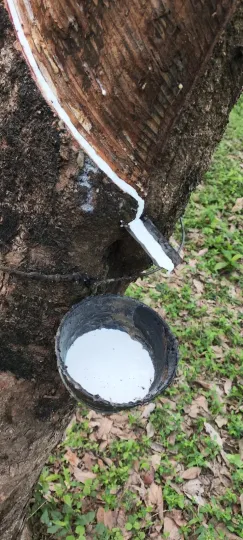
Harvesting latex involves a specialized technique known as tapping. This involves making a shallow diagonal incision through the bark of the trunk to stimulate the flow of latex from the laticiferous vessels.
Tapping is performed early in the morning to leverage the natural peak in turgor pressure of the tree and to ensure the latex remains liquid long enough to flow into the collection cup.
The latex is collected and transported to a processing facility where it is filtered and treated with acid to induce coagulation. The resulting solid rubber is then washed, rolled, and dried.
Technique is paramount: the tapper must avoid cutting into the cambium layer. Damage to the cambium can cause permanent scarring, inhibit growth, and reduce the future latex-yielding potential of the tree.
Regular maintenance of the tapping panel and adherence to established tapping intervals are essential for ensuring both immediate productivity and the long-term health of the plantation.