
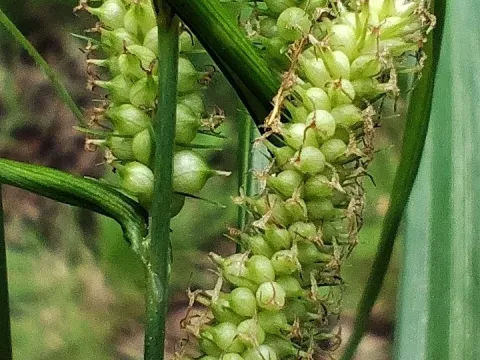
Olive Sedge
Carex olivacea
Olive Sedge (Carex olivacea) belongs to the Cyperaceae family and is a robust perennial grass native to parts of Asia. It is known for its graceful, arching leaves that feature a distinct olive-green hue, making it both a functional and ornamental plant.
What the section contains
Olive Sedge
Propagation is typically achieved through either seed germination or vegetative division of the root system. Seeds should be subjected to stratification to mimic natural winter conditions, which significantly improves the germination rate in spring.
Sowing in the field requires well-prepared, moisture-retentive soil. Seeds are sown in rows spaced 30 to 40 centimeters apart, allowing each plant sufficient space to develop a thick, healthy root structure during its first growing season.
Vegetative propagation via root division is often preferred in commercial nursery settings. By carefully dividing healthy mature clumps in early spring or autumn, growers can produce uniform plants that establish themselves much faster than seeds.
Early maintenance is crucial, as the young sedge grows relatively slowly. Keeping the planting area free of invasive weeds ensures that the Olive Sedge has access to essential nutrients and water without unnecessary competition.
As a hydrophyte by nature, Olive Sedge has high water requirements. It thrives in wetland areas, along riverbanks, or in gardens with consistently moist to waterlogged soil conditions.
The ideal soil for this species is rich in organic matter, such as loam or heavy clay soils. While it is adaptable, it performs best in neutral to slightly acidic pH conditions, which support its characteristic leaf coloration.
Olive Sedge exhibits significant plasticity regarding light exposure. It grows effectively in full sun provided the soil remains moist, but it is equally successful in partial shade, where the leaves may retain a deeper color.
The plant is relatively hardy and can survive cold temperatures, though it performs best in climates where it receives regular rainfall throughout the year. It does not tolerate prolonged drought, which causes leaf tips to brown and overall growth to stunt.
Agricultural management includes the application of balanced nitrogen-rich fertilizers during the active growth period to promote vigorous foliage development and maintain the structural integrity of the root mats.
The yield of Olive Sedge is primarily measured in biomass production, which is essential for land stabilization projects, erosion control, or raw material collection for artisan crafts and mulch.
Commercial plantations reach their peak yield potential around the third year. With appropriate maintenance, such as yearly thinning or cleaning of the clumps, these plantations remain productive for many consecutive seasons.
Regular harvesting of aged biomass stimulates the plant to produce new, fresh growth. This cycle is critical for maintaining high-quality foliage and ensuring that the plantation remains aesthetic and functional.
Seed production is secondary to biomass, but successful yield depends on ensuring optimal moisture levels during the flowering phase. Careful timing is needed to collect seeds before they are dispersed by wind or water.
The overall success of the yield is highly dependent on the density of the root network, which builds up over several years to form a dense, protective soil cover that is highly valued in environmental engineering.
Olive Sedge is naturally resilient against many common pests due to the high silica and tannin content in its leaves, which makes the foliage less palatable to many herbivores and insects.
However, in stagnant air conditions with excessive humidity, fungal diseases such as leaf rust or crown rot can develop. These issues are almost always related to improper spacing or lack of airflow in the field.
The primary control strategy is cultural management: maintaining correct spacing between plants, removing dead debris, and ensuring that water does not pool excessively around the crown of the plants for too long.
When necessary, biological fungicides can be used to manage fungal outbreaks. Because the plant is often used near water sources, avoiding harsh synthetic chemicals is recommended to protect the local ecosystem.
Monitoring the foliage for signs of discolored spots or necrotic patches allows for early intervention, ensuring that the health of the entire plantation is maintained without significant loss of biomass.
Harvesting usually takes place during the late summer or early autumn when the foliage has reached its peak size and firmness. This is the ideal time to ensure the highest quality of the harvested fibers.
Manual harvesting with sickles or mechanical harvesting with sharp, high-speed cutters is common. It is vital to cut the plants at a specific height above the soil to avoid injuring the rhizomes, which are essential for regrowth.
Once harvested, the material must be dried in a well-ventilated area to prevent mildew. Properly dried leaves can be stored for extended periods, maintaining their flexibility for various craft applications.
Seed collection involves cutting the flower stalks just as they turn brown. This ensures that the seeds are mature but have not yet been shed, allowing for maximum collection efficiency.
Following the harvest, field cleaning is an important practice. Removing the cut debris helps to reduce the habitat for overwintering pests and pathogens, setting the stage for a healthy following season.